
Physical security pay in 2026 can vary by $10,000 to $30,000+ based on clearance, industry, location, and experience. If I had to sum up the whole guide in one line, it would be this: general site security pays less, while cleared, technical, and leadership roles pay more.
Here’s the short version:
A few numbers stand out right away:
If you work in law enforcement or corrections, this matters even more. Skills like de-escalation, incident response, risk assessment, and report writing often transfer well into private-sector security jobs. That can move starting pay into the $60,000 to $80,000 range, with many senior or cleared roles reaching $90,000 to $130,000+.
Here’s a fast snapshot:
| Factor | What it can do to pay |
|---|---|
| Experience | Add $15,000–$25,000 |
| Industry | Add $10,000–$30,000 |
| Metro location | Add $5,000–$15,000 |
| Active clearance | Add $10,000–$30,000 |
| Certifications/tech skills | Add $5,000–$10,000 |
So if you want the plain answer: the best-paid physical security jobs in 2026 are usually in defense, federal-facing work, finance, and tech, especially when the role includes clearance, systems knowledge, or team lead duties.
The rest of the guide explains where each role tends to land and what usually pushes pay up or down.
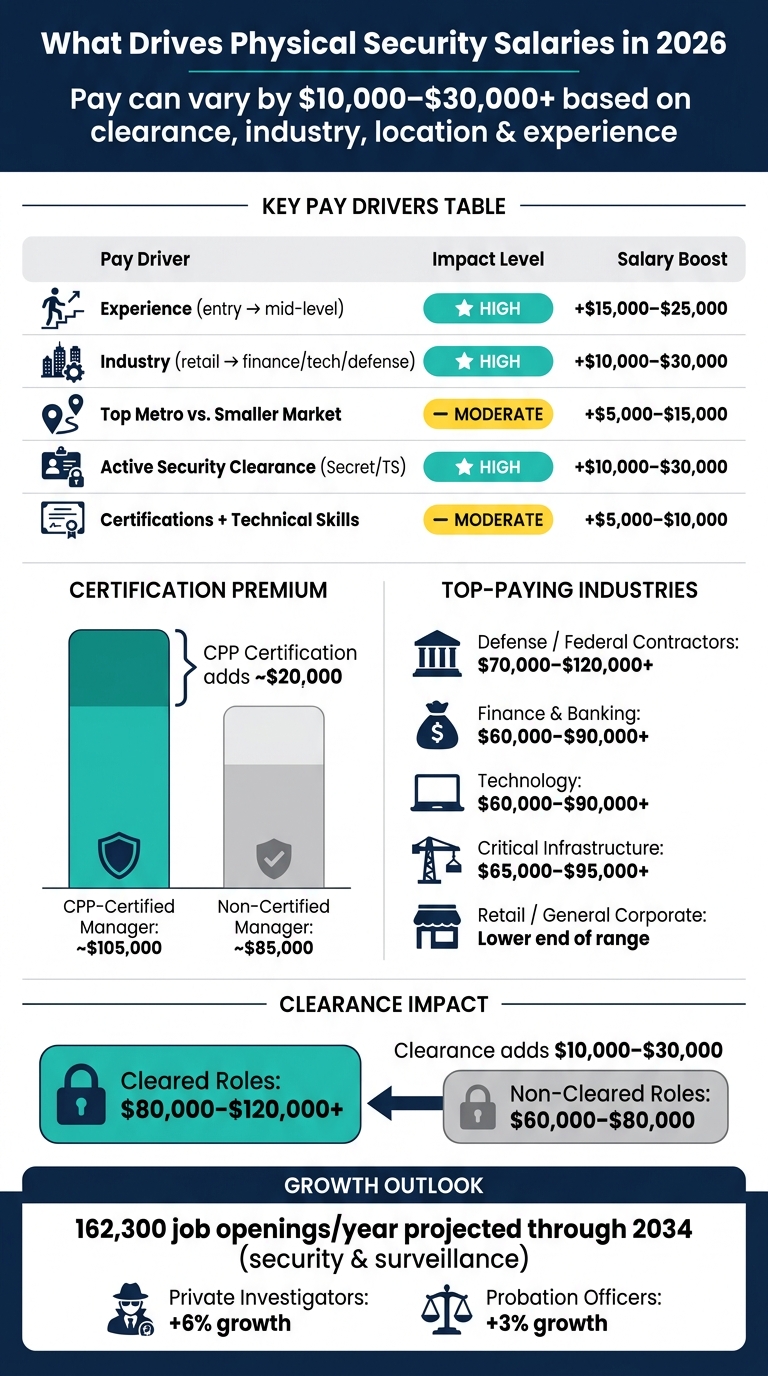
Physical Security Salary Factors 2026: What Moves Your Pay
With the baseline in place, the next piece is role-based pay. In physical security, salary can shift a lot depending on scope of work, industry, and how much technical or leadership skill the job calls for. The next subsections break down how 2026 pay changes by role and seniority, starting with specialist roles and then moving into corporate and senior positions.
This is usually where the pay range begins, then climbs as experience, judgment, and subject-matter depth grow.
Corporate security pay tends to move up when the job includes risk analysis, executive protection, compliance, or oversight across multiple teams.
Entry-level roles set the lower end of the range. Senior positions tend to pay more when they include team supervision, ownership of reporting, or specialized risk work.
Physical security pay in the U.S. doesn’t move on title alone. In 2026, experience, employer type, location, clearance, and credentials can shift pay by tens of thousands of dollars. That’s why two people with the same job title can land in very different salary bands.
| Pay Driver | Impact | Typical Salary Adjustment |
|---|---|---|
| Experience (entry → mid-level) | High | +$15,000–$25,000 |
| Industry (retail → finance/tech/defense) | High | +$10,000–$30,000 |
| Top metro vs. smaller market | Moderate | +$5,000–$15,000 |
| Active security clearance (Secret/Top Secret) | High | +$10,000–$30,000 |
| Certifications + technical skills | Moderate | +$5,000–$10,000 |
Experience is one of the biggest pay levers. Professionals who have led investigations, managed access control or CCTV deployments, or supervised teams often earn $60,000–$90,000. Once someone has 8+ years, owns programs, and handles cross-functional incident management, pay often moves into the $90,000–$130,000+ range at large enterprises.
Law-enforcement experience can move people into higher pay bands faster. Finance, tech, and critical infrastructure employers often pay more for former officers because they bring field-tested investigation skills, threat assessment experience, and the ability to lead workplace violence prevention programs with less ramp-up time. Former officers often start around $60,000–$80,000 and can reach $90,000+ in roles tied to policy development or incident command. OfficerList connects active and retired officers with employers that want this background.
Industry matters – a lot. Retail and general corporate roles usually pay less than jobs in finance, tech, and defense. The reason is pretty simple: higher risk exposure, tighter rules, and more complex security programs. In finance and tech, similar roles often land in the $60,000–$90,000 range or more.
Defense contractors and government-linked employers usually sit at the top end. Physical security specialists in those settings often see base pay of $70,000–$90,000+, and some roles go past $100,000 when clearances and industrial security duties are part of the job.
An active security clearance can change the math fast. Cleared physical security specialist roles at defense and federal-focused firms often pay $80,000–$100,000, with some jobs topping $120,000. Similar non-cleared roles often fall closer to $60,000–$80,000. Put bluntly, a smaller talent pool gives cleared candidates more leverage.
Location also shifts pay. Top metros tend to pay 15–25% more than smaller markets. New York, San Francisco, Washington, D.C., and Seattle stay near the high end for physical security salaries. A specialist role paying $60,000–$70,000 in a mid-size city can reach $70,000–$90,000+ in the D.C. area, helped by demand from defense firms and federal contractors.
Credentials can add another bump. ASIS PSP holders are estimated to earn about 22% more than peers without the certification. CPP-certified security managers earn about $105,000, compared with $85,000 without the credential.
Technical skill matters too. Professionals who design, implement, and audit access control, CCTV, and integrated security systems can earn a 5–15% premium, especially in tech, logistics, and critical infrastructure.
These factors help explain why physical security pay can move ahead of some nearby security roles.
Once you look past pay by role, the next useful comparison is nearby security jobs. This is where the gap starts to show. Corporate security and risk-focused roles tend to pay more when the job includes supervision, a broader set of duties, or clearance-related work.
Physical security and corporate protection overlap in a lot of ways. Both deal with incident response, investigations, and risk assessment. The difference is scope. Corporate security roles at businesses and institutions often come with team oversight, broader risk management duties, and, in many cases, state guard-card licensing.
That’s why corporate security often lands above physical security on pay when the role includes supervision or broader risk ownership. It’s not just about being on-site. It’s about being responsible for more moving parts.
Former corrections and law enforcement professionals often move into these roles with less friction. They’re already used to handling risk, managing access, and responding to incidents. That background helps explain why some physical security jobs pay closer to corporate security roles than to entry-level guard work.
Cybersecurity sits on a different path. The work centers on network defense, compliance, and threat monitoring rather than site protection.
For physical security professionals aiming for higher-paying hybrid roles, one of the clearest paths is to add skills in access control and security systems.
The biggest pay jumps usually come from roles that involve more specialization, discretion, and responsibility.
In plain English: the clearest way to earn more in physical security is to move beyond general guard work and into roles that pay for judgment, trust, and experience. Employers often put extra weight on candidates with law enforcement, investigative, or military backgrounds, especially for jobs like armed security, executive protection, and surveillance assignments. That’s what tends to move pay up – not just a new title.
If you’re a candidate, show the parts of your background that set you apart. Lead with function-based experience like:
It also helps to keep your state licenses and required certifications current, including guard, PI, and CPR/AED credentials.
If you’re hiring, spell out shift expectations and credential requirements from the start. That makes it much easier to attract retired officers and other qualified professionals who want flexible work without a lot of back-and-forth. It also helps you screen candidates faster.
For faster hiring and clearer applications, a focused marketplace can make the match between credentials and roles a lot simpler.
OfficerList connects employers with active and retired law enforcement officers for security and investigative roles, including armed security, executive protection, and surveillance assignments. The platform supports both direct-hire positions and per diem or contract work. Candidates can show their background clearly through resumes built for security roles, and employers can reach a pre-vetted pool of qualified professionals for high-stakes positions.
For candidates: Specialize, keep your credentials current, and go after roles that line up with your law enforcement or investigative background. That’s where the higher pay tends to be.
For employers: Define role requirements upfront and use a focused platform to reach qualified candidates faster.
In 2026, the top-paying physical and corporate security jobs tend to sit in leadership, specialized investigations, and high-level incident response.
Senior security management and crisis management roles often pay $85,000 to $150,000+ per year. Incident response consulting can reach $100,000 to $160,000+, and senior financial crime and fraud investigation roles may pay more than $180,000+.
Yes. In private security, a security clearance can help you earn more because higher-level jobs often require advanced clearances.
Pair that with specialized training or experience at a federal agency, and your profile gets a lot stronger. It can make you stand out for higher-paying, specialized roles, including jobs on OfficerList.
Focus on linking your on-the-job experience to what company leaders care about. Start with recognized certifications like the Certified Protection Officer (CPO). Then work toward higher-level credentials such as the Certified Protection Professional (CPP) if you want leadership or management roles.
It also helps to rewrite your resume so your security or law enforcement background reads like business value, not just job duties. Think in terms of measurable results, like budget oversight, team output, incident reduction, or staff management. OfficerList can help you connect with employers that look for that kind of background.