
Law enforcement is more connected than ever, thanks to advanced communication tools. From Computer-Aided Dispatch (CAD) to AI-driven analytics, these technologies are reshaping how officers respond to emergencies, manage data, and ensure public safety.
Here’s what you need to know:
Key Takeaway: Success depends on planning, training, and ensuring new tools work within existing systems. Agencies must also prioritize cybersecurity and community trust to fully benefit from these advancements.
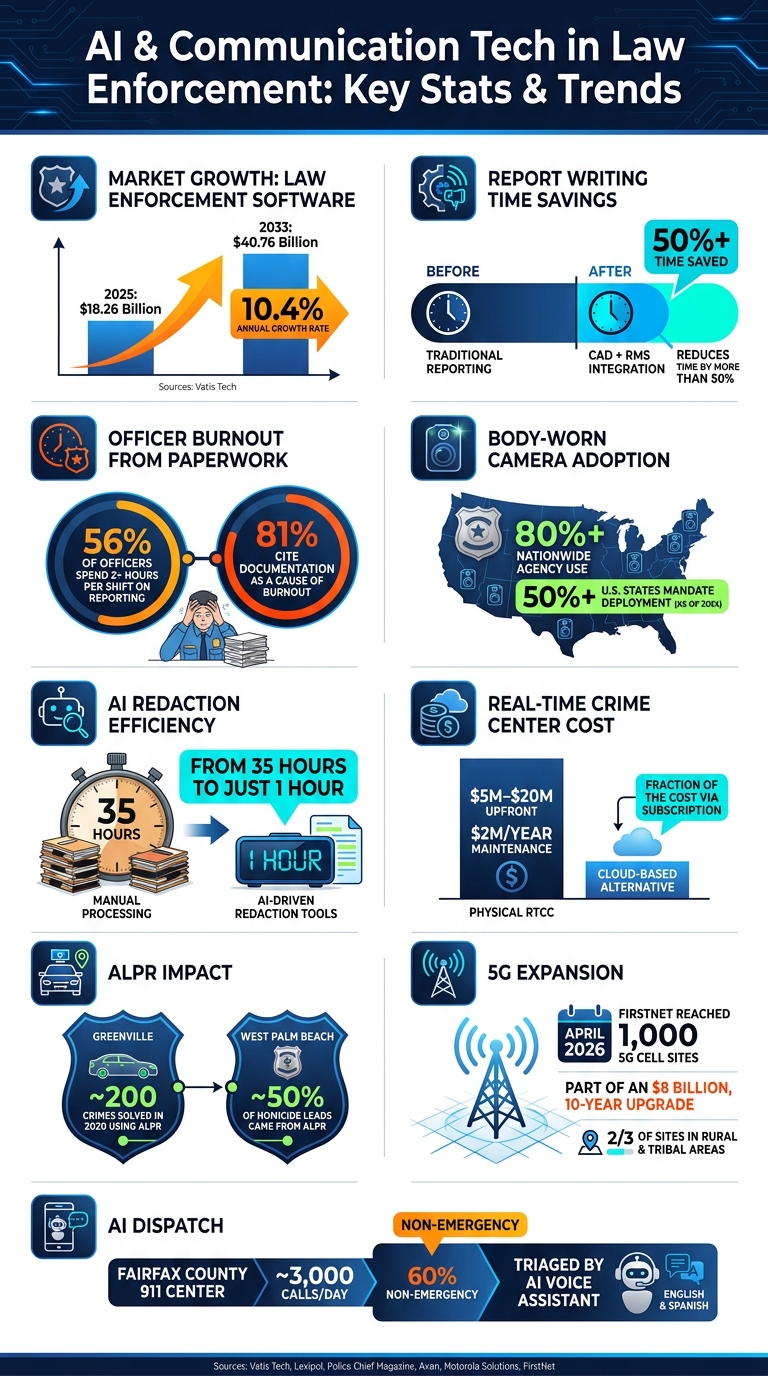
AI & Communication Tech in Law Enforcement: Key Stats & Trends
Modern law enforcement relies on a network of integrated systems, each designed to handle specific tasks. These systems are the foundation of contemporary policing, building on the communication tools discussed earlier. Understanding how these systems work together is critical for making informed technology choices.
CAD acts as the nerve center for real-time operations, while RMS serves as the archive for historical data. CAD oversees incidents from the moment a 911 call is received until resolution. It tracks unit locations using Automatic Vehicle Location (AVL), logs time-stamped records, and monitors officer status in real time. On the other hand, RMS holds detailed records such as arrest reports, criminal histories, and prior incidents.
When CAD and RMS are integrated, they can reduce report-writing time by more than 50%. For example, CAD can automatically pull historical data, such as a warning about a "hostile resident", before an officer arrives at the scene. It also pushes incident details directly into RMS, eliminating the need for manual data entry.
"The strongest automation in policing usually removes clerical delay, not human judgment." – Vatis Tech
Another feature, silent dispatch, sends incident details directly to officers’ devices, preventing eavesdropping. This seemingly small detail can have significant tactical advantages.
Today’s officers carry much more than a radio. Modern mobile devices allow direct access to databases like NCIC and Nlets, bypassing dispatch and speeding up decision-making. This also reduces the workload on dispatchers, allowing them to focus on higher-priority tasks.
Communication infrastructure is key here. Land Mobile Radio (LMR) remains essential for voice communication, particularly in areas with weak cellular signals. Meanwhile, LTE and 5G broadband support data-heavy tasks like streaming body camera footage, sharing suspect images, and accessing cloud-based records. Leading agencies combine these systems to avoid single points of failure.
"Mobile policing is no longer just radios and in-car laptops. It’s about building a connected ecosystem that integrates voice, video, data, AI and cloud-based tools into a seamless operational environment." – Dr. Michelle Gundy, Researcher and Consultant
In one real-world example from late 2025, Chief Dan Murphy of the Hillside Police Department in Illinois used situational awareness software to monitor a live video feed from an officer’s field system during a high-risk traffic stop. When the officer became unresponsive, command staff confirmed their safety remotely and de-escalated the backup response without waiting for additional units to arrive.
Beyond individual devices, cloud systems further enhance connectivity and coordination across departments.
Emergencies don’t respect jurisdictional boundaries, but older communication systems often do. Cloud platforms address this by providing multiple agencies with access to the same operational data – including CAD information, GPS tracking, ALPR hits, and drone footage – through a single, unified interface accessible from any connected device.
Building a physical Real-Time Crime Center (RTCC) can cost between $5 million and $20 million upfront, with $2 million in annual maintenance. Cloud-based solutions offer smaller departments similar capabilities at a fraction of the cost through subscription-based pricing.
"Disconnected tools create operational friction, slow decision-making and make it harder for agencies to operate as one coordinated team when seconds matter most." – Courtney Levin, Senior Branded Content Lead, Lexipol
To make cloud-based coordination effective across multiple jurisdictions, interoperability is critical. Systems must be able to share data not just within a department but with neighboring agencies. Before deployment, agencies should establish clear policies on data retention, access permissions, and audit trails to remain CJIS-compliant and maintain public trust.
Cloud and mobile integrations have paved the way for field tools that give officers real-time access to critical data, enhancing accountability and situational awareness. These tools work hand-in-hand with centralized coordination by delivering actionable insights directly to officers on the ground. Among these, body-worn cameras (BWCs) and automatic license plate recognition (ALPR) systems stand out for their transformative impact.
BWCs have come a long way from being basic recording devices. With over 80% of law enforcement agencies nationwide using them and more than half of U.S. states mandating their deployment as of 2024, BWCs are now essential tools in policing. But it’s not just about widespread use – these devices now offer advanced capabilities that redefine their role.
"The camera on an officer’s chest is not just a recording device. It is becoming an ecosystem of data, analytics and oversight." – Joshua Lee, Sergeant and Technology Expert
Modern BWCs are equipped with features like "Holster Aware" sensors that automatically start recording when certain events occur, such as a firearm being unholstered, a TASER being fired, or emergency vehicle lights being activated. Additionally, these cameras can capture 10–30 seconds of pre-event footage via buffering, ensuring critical moments are preserved. Systems like Motorola SVX take this further by synchronizing in-car and body cameras, so activating one device triggers all nearby cameras.
These advancements shift the focus from reviewing incidents after the fact to providing live situational awareness. For example, officers can now stream live video directly to dispatchers or Real-Time Crime Centers, allowing command staff to monitor incidents as they unfold. In 2025, the Kalamazoo County Sheriff’s Office demonstrated this capability when they used Axon Body 3 cameras to locate officers lost during a nighttime pursuit. Despite being just 300 yards from their rescue team, the officers couldn’t hear sirens due to dense forestry, but live GPS and video feeds made the rescue possible.
ALPR systems are another game-changer, enhancing the precision of law enforcement responses. These systems use high-speed cameras, infrared imaging, and optical character recognition (OCR) to scan license plates and match them against databases for stolen vehicles, active warrants, and Amber Alerts. Each scan logs a photo, plate image, GPS coordinates, and timestamp. When paired with in-car navigation, this data enables officers to track vehicles and adjust response routes in real time.
The results speak for themselves. In Greenville, ALPR systems helped solve nearly 200 crimes in 2020, while in West Palm Beach, nearly half of homicide leads came from tools like ALPR.
| System Type | Deployment | Primary Use |
|---|---|---|
| Fixed | Light poles, intersections | Continuous monitoring of high-traffic areas |
| Mobile | Patrol vehicle bumpers/roofs | Coverage in areas lacking fixed infrastructure |
| Portable | Trailers, speed signs | Temporary monitoring for specific investigations or residential areas |
It’s important to note that an ALPR hit alone doesn’t establish probable cause. Officers must visually confirm the plate matches the vehicle and verify its status through law enforcement databases before taking action. To address privacy concerns, agencies should adopt transparent policies on data retention and access audits. At least 14 states have already enacted laws governing ALPR use.
AI is transforming how police departments handle tasks, freeing up officers to focus on their core responsibilities. From managing 911 calls to filing reports, AI-powered tools now take on time-consuming duties that used to dominate officers’ shifts. The global law enforcement software market reflects this shift, with projections showing growth from $18.26 billion in 2025 to $40.76 billion by 2033.
One of AI’s standout contributions lies in breaking down data silos. Modern platforms integrate information from body-worn cameras, 911 audio recordings, ALPR (Automated License Plate Recognition) hits, and forensic lab results into a single, searchable system. What used to take detectives days to connect can now be done in moments. Machine learning enhances this process by identifying patterns and connections across multiple cases and jurisdictions – patterns that would be nearly impossible for any individual officer to spot.
AI also plays a major role in resource allocation. Predictive algorithms analyze past crime data to pinpoint high-risk areas and times, helping law enforcement deploy patrols more effectively. For example, in April 2026, the Las Vegas Metropolitan Police Department, under Sheriff Kevin McMahill, adopted Motorola Solutions‘ CommandCentral RMS. This AI-powered system, featuring the "Assist" tool, streamlines investigative processes, automates administrative tasks, and keeps officers in the field rather than stuck behind desks.
"Our priority is keeping our officers in the community, not sitting behind a desk doing paperwork. We’re unifying our investigative intelligence… and automating mundane administrative tasks with Assist to fundamentally change how our officers spend their time." – Kevin McMahill, Sheriff, Las Vegas Metropolitan Police Department
This focus on efficiency also extends to reducing the heavy documentation load officers face daily.
Paperwork is a significant challenge in policing. Surveys show that 56% of officers spend three or more hours per shift on reporting, while 81% cite documentation as a cause of burnout. AI steps in here with tools that automate transcription and assist with drafting reports by pulling data from multiple sources.
In January 2026, Fairfax County, Virginia’s 911 center implemented an AI voice assistant from Prepared by Axon. Handling about 3,000 calls daily, including 60% non-emergency calls, the system triages routine requests in English and Spanish. This allows human dispatchers to focus on critical emergencies. The platform’s effectiveness was evident in August 2025, during a high-stakes rescue in Ohio. Using its auto-transcription feature, dispatchers tracked every radio transmission in real time, aiding in the rescue of four capsized boaters located seven miles offshore.
"There’s a several-minute delay to get a language unless the initial call responder is a Spanish speaker… transcription to me is a game-changer." – Monica Million, Former President, NENA
These tools are particularly valuable in high-pressure, multilingual dispatch environments where speed and precision are paramount.
AI-driven redaction tools are also transforming how agencies manage public records requests. Some agencies have reported a drop in processing time from 35 hours to just one hour, making it easier to meet transparency demands. However, it’s crucial to treat AI-generated outputs as investigative leads, not definitive conclusions. Human oversight remains essential to ensure accuracy, maintain evidentiary standards, and uphold public trust. For more insights on modern policing, explore our law enforcement blog.
Bringing new communication tools into law enforcement operations requires more than just purchasing the latest gadgets. Success depends on how well-prepared the agency is to integrate these tools. Jumping into implementation without laying the groundwork can lead to wasted resources and frustration. Careful planning is essential to ensure these tools truly benefit the organization.
"If agencies spend millions of dollars… only to have the governing bodies or community refuse to allow the full use of a chosen technology… the result involves much wasted time and money because the policy was not developed or enhanced alongside procurement." – James Emerson, Robert Nanney, and David Shipley, Police Chief Magazine
Before investing in new technology, agencies need to take a hard look at their existing infrastructure. This includes evaluating network coverage, redundancy, and interoperability. For example, systems like hybrid LMR-LTE can ensure uninterrupted voice and data communication, but only if the infrastructure is ready to support them.
The table below highlights key infrastructure components that agencies should assess before rolling out new tools:
| Infrastructure Component | Role | Upgrade Needs |
|---|---|---|
| Hybrid LMR-LTE | Ensures reliable voice and data communication | Devices capable of dual operation (P25 + LTE) |
| 5G Networks | Supports high-speed video and AI applications | Deployment of small cells and 5G-compatible hardware |
| Cybersecurity | Protects sensitive data | Implement zero-trust architecture and multi-factor authentication (MFA) |
| Cloud CAD/RMS | Facilitates inter-agency coordination | Requires high-speed broadband and secure VPNs |
| Edge Computing | Enables local data processing | Rugged handheld devices with AI processing capabilities |
Training is just as critical as infrastructure. It’s not enough to teach officers how to operate devices; they also need to understand the risks associated with digital tools. Cybersecurity training, for instance, should focus on recognizing phishing attempts, creating strong passwords, and reporting suspicious activity as part of their routine.
"Cybersecurity must become part of agency culture. Officers and staff should be trained not just on how to use devices, but how to identify phishing attempts, create strong passwords, and report suspicious activity." – Dr. Michelle Gundy, Researcher and Consultant
Even with the best infrastructure, the human element can make or break a technology rollout. Officers often resist new tools if they’re cumbersome or disrupt workflows. For example, devices that add bulk to uniforms or require complex interactions in high-pressure situations can lead to frustration. The solution? Include frontline officers in the decision-making process. Their input can help identify usability issues early, saving time and money.
Phased rollouts can also ease resistance. Instead of replacing entire systems at once, agencies can gradually layer new capabilities onto existing platforms. For instance, network gateways can bridge older analog radios with modern P25 systems, allowing for a smoother transition. The Hillside Police Department in Illinois demonstrated this in 2025 by running P25 radios alongside LTE. When a voice radio failed during a traffic stop, Chief Dan Murphy used integrated situational awareness software to verify the officer’s safety through a live video feed – seamlessly combining old and new technologies.
"The radio is not a legacy tool; it is your fail-safe. The real future of public safety technology isn’t a device that replaces the radio – it’s a platform that makes the radio go further with LTE and AI." – Chief Dan Murphy, Hillside Police Department
Data quality is another critical factor. Automated reporting tools can reduce paperwork and improve accuracy, but they’re only as good as the data they process. Agencies should establish auditing and review cycles from the start to ensure data remains clean and consistent. Regular technology reviews – at least annually – can help confirm that tools are still meeting operational needs.
For agency technology to succeed, it must earn community trust. This trust hinges on clear policies, open communication, and strict accountability. Below, we’ll explore the key issues of privacy, bias, and transparency.
Strong governance starts with addressing privacy and bias risks. Many of these risks stem from human factors in communication technology. AI systems, for example, often reflect the biases present in their training data. Without proper oversight, these biases can subtly affect decisions, such as how resources are allocated or which evidence is flagged. A striking example occurred in July 2025, when the Westbrook, Maine Police Department faced backlash after an officer used ChatGPT to add a department badge to a drug seizure photo. The AI distorted the image, leading to public criticism and initial denials from the department. Eventually, they issued an apology, posted the unaltered image, and discontinued AI use in social media content.
"Public trust is the foundation of all police, fire and government communication. That trust erodes when people feel like they’re being spoken to by a machine, not a person." – John Guilfoil, Founder, JGPR
Protecting privacy requires more than promises – it demands concrete policies and enforcement. For instance, a 2020 U.S. Department of Justice directive requires agencies to safeguard personally identifiable information (PII), such as driver’s license numbers and criminal records. One effective approach is tiered encryption. This method keeps primary dispatch channels open to the public and media while encrypting sensitive tactical communications used by specialized units.
Transparency and accountability are just as important as privacy when it comes to maintaining public trust. Agencies that openly share their policies and practices stand apart from those that operate in secrecy. A key element of transparency is the "human-in-the-loop" requirement, ensuring that AI doesn’t operate independently in public communications. Governance frameworks should also include community involvement during technology procurement. Engaging retired LEOs and local leaders early in the evaluation process can help address concerns about bias and transparency.
Governance is as crucial as infrastructure and training in deploying communication technology effectively.
| Governance Category | Essential Framework Component |
|---|---|
| Transparency | Disclosure of AI usage; public-facing policy documents |
| Accountability | Human-in-the-loop requirements; audit trails for data access |
| Privacy | Tiered encryption; compliance with DOJ PII directives |
| Bias Mitigation | Human verification of all AI-generated claims and statistics |
One area where accountability often falters is informal communication. Using consumer apps like Signal or WhatsApp can undermine audit trails and make public record compliance impossible. This lack of official records highlights the need for fully managed, CJIS-compliant platforms. As Richard Danforth, CEO of Genasys Inc., points out, "When official and/or confidential information flows through unmanaged channels, agencies lose control over who received it, where it went, whether it still exists, and whether it can be defended later". Adopting CJIS-compliant messaging tools can close this gap, ensuring agencies remain legally secure and operationally accountable.
The law enforcement technology market is expected to reach $40.76 billion by 2033, with an impressive 10.4% annual growth rate beginning in 2026. This projection highlights how central technology has become to modern policing operations.
One of the most immediate transformations in this space is the shift from disconnected tools to unified platforms. Currently, many agencies juggle separate systems for CAD, ALPR, drone feeds, and body cameras. The next wave of technology aims to bring all these elements together into a single, streamlined interface. As Jay Draisin, Chief Product Officer at LeoSight, explains:
"We want everyone on the same map. We want everyone using the same communication platform – it’s one incident, one response."
This push for unified platforms relies heavily on advanced, reliable networks, paving the way for next-generation connectivity.
5G technology is at the heart of this evolution. Its low latency and high bandwidth capabilities make real-time data sharing a reality. This means body-worn cameras and drone footage can be streamed directly to command centers, biometric checks can be performed on the spot, and, in the future, augmented reality (AR) overlays could provide tactical information like building layouts or suspect locations. FirstNet‘s milestone of 1,000 5G cell sites in April 2026, as part of an $8 billion, 10-year upgrade, has been a game-changer. Over two-thirds of these sites are in rural and tribal areas, significantly boosting operational capabilities for agencies in underserved regions.
While 5G lays the groundwork for real-time communication, AI innovations are poised to redefine field operations.
"In the next decade of law enforcement, communication won’t just support the mission. It will shape it." – Dr. Michelle Gundy
One promising development is edge processing, which allows AI to operate directly on an officer’s device instead of relying on cloud-based analysis. In 2026, an Illinois department piloted edge-enabled devices for real-time language translation during interactions in the field. This technology not only streamlined communication but also ensured officers could stay focused on engaging with the public. It’s a clear example of how AI can enhance efficiency without adding complexity.
Looking further ahead, agencies that prioritize interoperability and cybersecurity will be best equipped to handle these advancements. As networks become more interconnected, each new device introduces potential vulnerabilities. Building systems with zero-trust architectures and end-to-end encryption from the outset – rather than retrofitting them later – will be key to maintaining security. Agencies that treat these principles as core requirements will be better positioned to adapt to the rapidly evolving communication landscape.
These advancements underscore the critical role technology will play in shaping the future of law enforcement, challenging leaders to stay ahead in an increasingly connected world.
The main point here is simple: technology alone won’t solve problems – it’s the strategy behind it that makes the difference. Whether it’s CAD systems, body-worn cameras, AI-driven analytics, or 5G networks, the success of these tools depends on thoughtful planning, clear policies, and a consistent effort to integrate them effectively.
This guide has highlighted the essential mix of technology, security measures, and human strategies that modern policing demands.
Start by auditing your current infrastructure. This helps identify coverage gaps, outdated systems, and interoperability challenges before making any major purchases. As Chief Chris Moore, former Chief of Police in San Jose, wisely stated:
"The key to successful implementation is strong leadership commitment, comprehensive training, frequent interoperability testing and robust cybersecurity measures."
Cybersecurity should be a top priority. Every connected device introduces a potential vulnerability. Investing in zero-trust architectures and end-to-end encryption early can significantly reduce the cost and damage of future breaches. Maintaining hybrid LMR-LTE systems is equally important to avoid relying on a single network during critical incidents.
The human factor is just as crucial. Involve frontline officers from the start and provide thorough training – not just on how to use the tools, but also on digital safety practices like spotting phishing attempts and managing credentials. If officers don’t trust or understand the technology, it won’t deliver the results you’re aiming for.
Before making any upgrades, take a close look at your current infrastructure. This means identifying outdated systems, spotting coverage gaps, and checking how well your setup works with newer tools. A security audit should be at the top of your list – look for vulnerabilities like phishing risks or malware exposure. Make sure your devices are equipped with encryption and multi-factor authentication for added protection.
You’ll also want to assess how smoothly your systems work together (interoperability), whether users have the skills to operate them effectively, and if your hardware is built to last. Lastly, confirm that your infrastructure can handle a multi-network strategy. This helps reduce the risk of single points of failure, keeping your operations more resilient.
Ensuring seamless communication between CAD, RMS, and field tools demands effective governance, clear procedures, and well-integrated technology. Focus on CAD-to-CAD systems to enable real-time data exchange without the need for expensive system replacements. A hybrid communication approach – using both LMR radios and LTE broadband – provides critical redundancy for uninterrupted operations. Incorporating open standards like P25, NENA i3, and the SAFECOM Interoperability Continuum helps maintain compatibility across various agencies and jurisdictions.
Agencies can integrate AI into their operations responsibly by adopting a few key practices. First, prioritize edge processing to ensure data remains local and secure, reducing risks associated with centralized data storage. AI can also be utilized for tasks such as redacting public records, which promotes greater transparency while safeguarding sensitive information. Additionally, AI-driven analytics can help allocate resources more objectively, ensuring fair and efficient decision-making.
To maintain ethical AI use, agencies should focus on addressing potential biases in AI systems, ensuring compliance with security standards like CJIS (Criminal Justice Information Services), and prioritizing accuracy in all applications. These steps not only improve operational outcomes but also help build and sustain public trust.