
A physical security risk assessment evaluates your site to find vulnerabilities and improve safety. It focuses on areas like access points, lighting, surveillance, and emergency procedures. The process also reviews operating policies, tests security systems, and identifies risks based on location, workforce, and operations. Key steps include:
Regular assessments (every 2–3 years or after major changes) help maintain security and reduce risks effectively.
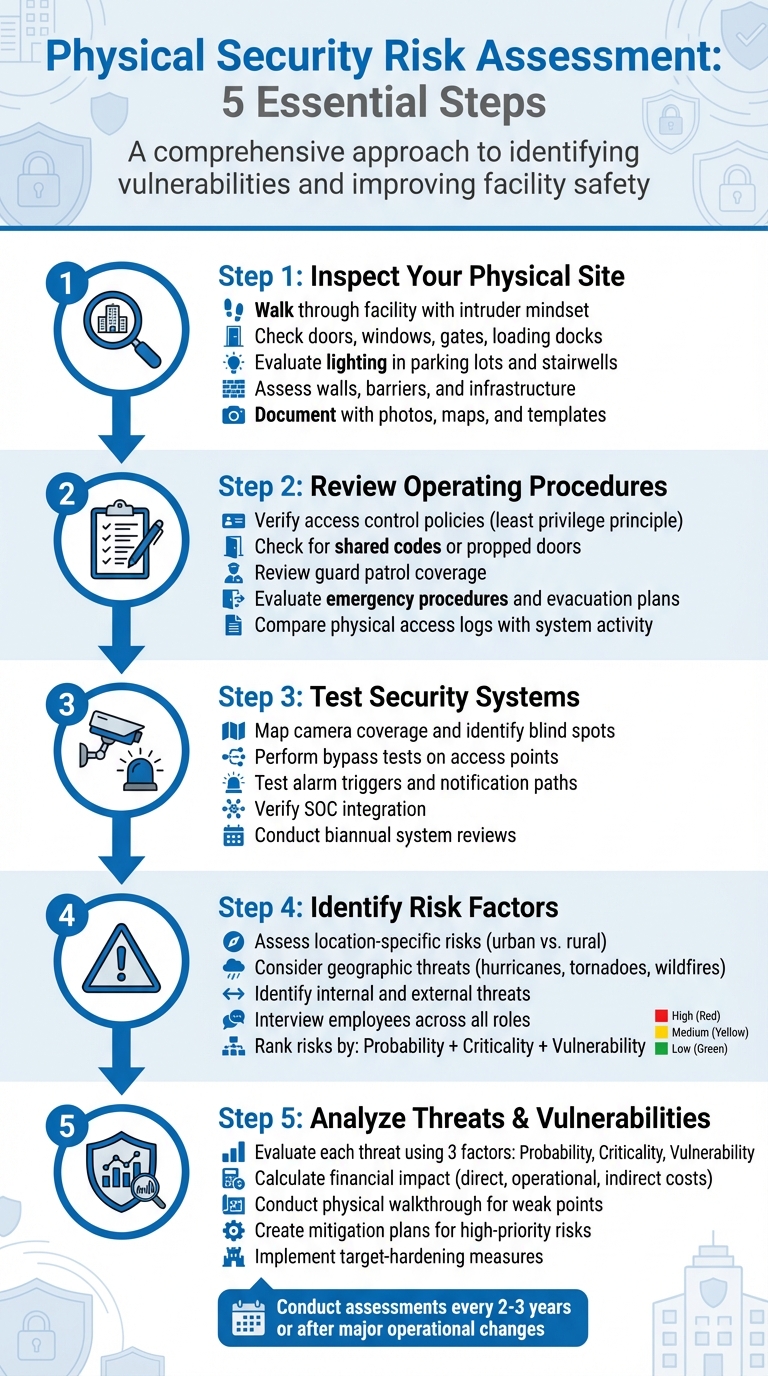
5-Step Physical Security Risk Assessment Process
The first step in assessing physical security risks is to conduct a detailed walkthrough of your facility. This involves closely observing the site to identify vulnerabilities that might not be apparent from plans alone. Walk through every area with the mindset of an intruder, keeping an eye out for structural weaknesses, lapses in maintenance, or employee habits that could undermine security. This step sets the stage for reviewing procedures and testing systems later on.
Start by focusing on the most critical access points. Examine doors, windows, gates, and loading docks to confirm they close and lock securely. Look for issues like propped-open doors or unsecured gates. Evaluate the lighting in parking lots, stairwells, and secluded corners – adequate lighting reduces potential hiding spots. Also, check sightlines around entrances and exits; clear visibility is essential for effective monitoring, whether by security personnel or cameras.
Beyond access points, inspect the overall condition of the facility. Assess walls, windows, and physical barriers for signs of wear or damage that could weaken their protective role. Check electrical systems for fire hazards and plumbing for leaks that might lead to costly damage. Pay special attention to areas housing critical assets, like evidence rooms, communication equipment, or firearms storage, ensuring they are securely separated from general-access spaces. Additionally, verify that fire extinguishers, smoke detectors, and emergency exits are operational and clearly marked.
Use standardized templates, photographs, and maps to document your inspection process. Categorize vulnerabilities and strengths based on the likelihood of incidents, potential impacts, and existing preventive measures.
"Reporting and documentation formalize your physical security assessment and turn insights into action. Clear, well-structured reports help communicate risks, prioritize response efforts, and support leadership in making data-driven security decisions."
Once you’ve examined your physical site, it’s time to focus on how your security policies function in real-world scenarios. Even the most advanced locks and surveillance systems won’t help if the procedures supporting them are weak or inconsistently followed. This step helps you identify gaps between written policies and everyday practices, as well as uncover any shortcuts or habits that could undermine security. It also lays the groundwork for testing and improving your protocols in later steps.
Take a close look at who has access to various areas and ensure those permissions match their job responsibilities. Stick to the "least privilege" principle – only grant access to spaces that are absolutely necessary for someone’s role. Investigate whether former employees still have physical keys or active access codes, as this could pose a serious risk. Compare physical access records, like badge scans, with system activity logs to spot inconsistencies, such as someone logging into systems after hours without a corresponding physical entry. If staff interviews reveal shared keypad codes or doors left propped open, these are red flags that your official policies aren’t being followed.
Evaluate how well routine security tasks are carried out and documented. Are guard patrols covering all critical areas, especially during off-hours? Look into how high-value or portable items are managed – are they secured during shift changes or breaks? Check the protocols for overnight crews and contractors to ensure they don’t allow unauthorized access. Clear and detailed documentation of all procedures is essential to avoid confusion about what is acceptable during normal operations versus emergencies.
Examine your plans for responding to major incidents like active shooters, robberies, fires, or natural disasters. Make sure evacuation plans are up-to-date and that emergency exits are clearly marked. Changes to a facility’s layout, such as renovations, can create hidden vulnerabilities if evacuation maps aren’t updated. Test your communication systems to confirm that all staff members know how to use the organization’s emergency alert tools effectively.
Once you’ve reviewed your procedures, it’s time to put your security technology to the test. This ensures that all systems are functioning as expected. Hardware and software can fail or develop vulnerabilities over time, leaving your facility exposed. Testing helps you move from reacting to issues to actively preventing them, catching problems before they can be exploited. Focus on key areas like surveillance, access control, and alarm systems – these are the core components of your physical security setup. This technical assessment works hand-in-hand with your earlier procedural review.
Begin by mapping out camera coverage to identify any blind spots around entry points, exits, and sensitive areas. Physically inspect each camera’s view by walking through your facility. Look for obstructions such as new furniture, signs, or even overgrown plants that might block critical sightlines. Measure lighting levels (in lux) to ensure cameras can clearly capture footage – poor lighting is a frequent weak point.
Confirm that your cameras are properly integrated with your Security Operations Center (SOC). Simulate test events to ensure personnel can quickly access live feeds and respond in real time. Audit all supporting hardware, like monitors, storage devices, and recording quality. Pay special attention to monitoring schedules, as gaps often occur during shift changes or overnight hours. Use photos and diagrams to document any uncovered blind spots or hardware issues.
Perform bypass tests at access points to verify that alarms are triggered when someone attempts unauthorized entry. Check keycards, biometric scanners, and smart locks to ensure they are restricting access to authorized personnel only. These systems should also be integrated with your alarm network so that any breach immediately alerts the SOC or law enforcement, providing details like time and location.
Review access permissions to confirm that the "least privilege" principle is being followed, meaning employees only have access to areas necessary for their roles. Check off-hours protocols to make sure no security gaps exist during times when fewer staff are on-site. Inspect physical components like wiring and electrical systems for wear and tear, as these could fail during power outages. Additionally, train staff to effectively use security tools while staying open to adopting better technologies as they emerge.
Ensure that alarm systems promptly notify your SOC or local law enforcement when triggered. Test motion sensors, glass break detectors, and other alarm triggers to confirm they activate correctly and send accurate alerts. Double-check notification paths so alarms reach the right people immediately, avoiding delays caused by system queues.
Track and document alarm response times, sensor reliability, and any integration issues. Experts recommend conducting biannual security system reviews to keep up with new threats and technological advancements. It’s also a good idea to run targeted tests after facility renovations, equipment upgrades, or security incidents to ensure your systems remain reliable and effective.
After completing system tests, it’s time to pinpoint the specific risks your facility faces. These risks are shaped by factors like location, size, and workforce, creating a unique profile for your operation. This step goes beyond hardware inspections, focusing on real-world vulnerabilities that could affect your security. You’ll need to consider both the sources of potential threats and their possible impact on your operations.
Your facility’s location plays a critical role in determining its security risks. Urban areas often face challenges like parking lot incidents and vandalism, while rural locations might deal with slower emergency response times.
Geography also introduces unique risks. Coastal facilities may need hurricane plans, while inland sites should prepare for tornadoes. Northern locations must account for snow and ice, whereas southern areas should be ready for wildfires. Even internal decisions, like placing server rooms in basements, can increase risks such as flooding.
Walk around your facility’s perimeter and take note of external vulnerabilities. Are parking lots well-lit? Are there blind spots caused by nearby structures? Does street traffic make entry points more visible – or less secure? Reviewing local crime statistics can reveal common risks, such as vandalism or theft. Facilities near industrial zones might also face secondary hazards, like chemical spills or manufacturing accidents.
Once you’ve assessed external factors, turn your attention inward to identify internal risks.
Threats generally fall into two categories: external and internal. External threats include natural disasters, local crime, terrorism, and supply chain disruptions. Internal threats stem from issues like unauthorized access, theft, or other employee-related vulnerabilities that may require armed security officers.
To get a complete picture, interview employees across different roles. Their insights might reveal risks you wouldn’t catch through external reviews alone. For instance, frequent tailgating at a specific entrance could signal a security gap. Historical incident data can also help you spot recurring issues. Additionally, consider factors like workforce turnover and the number of visitors your facility handles daily, as these can influence your overall risk profile.
Move beyond standard checklists by conducting comprehensive reviews. Look at how your facility’s layout and daily operations might unintentionally create vulnerabilities.
Once threats are identified, the next step is determining which ones demand immediate attention.
Not all risks are equal. To address them effectively, rank them based on three key factors: Probability (the likelihood of the event), Criticality (how much it could disrupt your operations), and Vulnerability (how well-prepared you are to handle it).
Focus on areas that score high across these three factors. According to the Security Executive Council, "Highest priority should be given to those areas that have high values for probability, criticality, and vulnerability". On the other hand, risks with low scores shouldn’t consume too much of your budget or resources.
To quantify risks, calculate their financial impact. This includes direct costs (like replacing damaged equipment), operational costs (lost revenue or staff hours), and indirect costs (such as reputational damage or intellectual property loss). Use tools like color-coded severity charts – red for urgent, yellow for moderate, and green for low – to make priorities clear. Tailor your reports for different audiences: executives need high-level financial summaries, while security teams require detailed, technical breakdowns.
Once you’ve prioritized risks in Step 4, it’s time to dig deeper. This step is all about pinpointing where your defenses may be lacking. You’ll evaluate the likelihood of each threat, the potential damage it could cause, and how well your current security measures stand up against it.
To effectively evaluate threats, focus on three key factors: Probability (how likely the threat is to occur), Criticality (the severity of its impact), and Vulnerability (how well your existing defenses hold up). These elements help identify which threats demand immediate attention.
For instance, a facility in a high-crime urban area faces different risks than one in a quiet suburban neighborhood. Criticality considers the potential fallout – business interruptions, legal liabilities, revenue losses, and even reputational harm. Vulnerability highlights the gaps in your current security measures, such as physical barriers or procedural safeguards, and how well they address each specific threat.
It’s also essential to assess the financial impact of these risks. Break down costs into direct, operational, and indirect categories. This analysis not only clarifies the stakes but can also help you justify security investments to decision-makers.
Once you’ve completed these evaluations, you’ll have a clear picture of where your vulnerabilities lie.
Vulnerabilities are the weak points in your security system that threats could exploit. As the Security Executive Council puts it:
Vulnerability is a dynamic concept. It changes whenever your environment, operations, personnel, business and/or systems change
. This means you can’t rely on static checklists. Instead, you need to analyze how your systems operate in real-world scenarios.
Start by conducting a physical walkthrough of your facility, paying close attention to weaknesses like poor lighting, obstructed sightlines, broken locks, or surveillance blind spots. Speak with employees at all levels – they often notice issues that external audits miss. Reviewing historical incident data can also reveal patterns that point to deeper problems.
Implement the least privilege principle to limit access to only what’s necessary for each role. Also, evaluate how well your security systems work together. For example, ensure alarms notify the right personnel when access controls are breached, and check for any gaps in surveillance monitoring.
This thorough analysis will guide the development of targeted mitigation strategies.
Focus your resources on vulnerabilities with the highest combination of probability, criticality, and vulnerability. Areas with consistently low scores in these categories shouldn’t consume more than their fair share of your budget.
For high-priority vulnerabilities, create specific mitigation plans. Consider target-hardening measures such as upgrading physical barriers, enhancing access controls, expanding surveillance coverage, deploying trained security personnel, or installing alarm systems. A cost-benefit analysis can help weigh the expense of these measures against the potential cost of a breach.
Tailor your plans to your audience. Executives typically need concise reports with clear financial justifications, while security teams require detailed technical instructions. Joe Holokan, Manager of Central Region Security at Cox Enterprises, emphasizes the importance of flexibility:
Security is very reactive. With a flexible plan, you can change direction on a dime. Ensure you have the right technology and staff trained to take advantage of it – and always look out for better tools
.
Make it a habit to review and update your mitigation plans at least twice a year or whenever major changes occur in your operations, staffing, or environment.
Before starting an assessment, it’s crucial to define the scope, assign responsibilities, and determine the level of risk your organization is prepared to accept. Skipping this step can lead to wasted resources and an incomplete evaluation that overlooks critical vulnerabilities.
Start by identifying the facilities and assets that will be part of the assessment. Clearly list specific locations and outline what you’re protecting – whether it’s classified information, firearms, or specialized equipment . Establish clear operational and physical boundaries so your team knows exactly where the assessment starts and ends.
Your objectives should address a key question posed by the Security Executive Council:
"Do I want to correct a problem or reduce a potential risk?"
Decide if your focus is on improving overall security, meeting regulatory requirements like HIPAA or ISO 27001, or protecting high-value assets. Don’t forget to factor in operational considerations, such as work schedules, how people and materials flow through your facility, and the risk level associated with your industry.
Involve key stakeholders early in the process. Bring in executive leadership, facility managers, and security personnel to ensure the assessment aligns with your organization’s goals and culture. The team leader should also develop a detailed workplan before starting the evaluation. This plan should include deliverables, required resources, budget, and timelines.
Once the objectives are set, the next step is to assemble a capable team to carry out the assessment.
Create a team that blends internal expertise with external perspectives. Internal security staff bring valuable insights into daily operations , while facility managers can evaluate physical infrastructure like lighting, entry points, and plumbing. Executive leadership ensures the assessment stays connected to broader business priorities.
To gain an outside perspective, consider hiring external security consultants. Look for consultants who can manage the process from assessment to implementation of recommendations. Don’t underestimate the value of feedback from employees at all levels – frontline staff often spot vulnerabilities that might be missed in top-down evaluations. Using a delegation matrix to clarify who has the authority to approve security measures or accept specific levels of residual risk can streamline decision-making.
For law enforcement professionals interested in contributing their expertise, platforms like OfficerList (https://officerlist.com) offer resources and a community to help build a well-rounded team.
With your team in place, the next step is to define acceptable risk levels.
Establish your organization’s risk tolerance – whether it’s Low, Medium, or High – to guide your mitigation efforts. This involves evaluating residual risk (the risk remaining after safeguards are applied) and comparing it to a target level set during preparation.
Focus on areas with a high likelihood of occurrence, critical importance, and significant vulnerabilities. As the Security Executive Council points out:
"When the values for a particular area add up to an unacceptable level of risk, it is vital that you lower one or more of them by implementing security measures."
On the other hand, areas with consistently low risk levels shouldn’t drain resources that could be better used elsewhere.
A three-point analysis – covering material, operational, and indirect costs – can help justify security investments and ensure that risk levels align with available resources.
Finally, formalize a delegation matrix that specifies which management levels can approve certain risk tolerances. For example, senior executives might handle high-risk decisions, while supervisors manage low-risk ones. Since risk tolerance isn’t static, review these levels at least twice a year or whenever significant operational changes occur .
A physical security risk assessment provides a comprehensive review of your facilities, security systems, and operational procedures in light of specific threats. This process uses three key principles to guide the evaluation: Probability (the likelihood of an incident), Criticality (the potential impact on operations), and Vulnerability (how well current safeguards perform). These principles should shape your next steps.
Document your findings in actionable reports, including visual tools like severity charts and cost-benefit analyses, to support recommendations for upgrades. This documentation not only addresses immediate concerns but also helps inform long-term strategies, enabling leadership to make informed decisions about resource allocation and security priorities.
"Security is very reactive. With a flexible plan, you can change direction on a dime. Ensure you have the right technology and staff trained to take advantage of it – and always look out for better tools".
Schedule reviews at least twice a year to stay ahead of evolving threats, organizational changes, and advancements in technology. Additional assessments should be triggered by significant operational, personnel, or environmental changes. Regular evaluations and adaptable planning are critical to maintaining strong security protocols and addressing the challenges identified during your assessments.
After completing a thorough assessment, consider expanding your professional opportunities. Industries such as healthcare, finance, education, and critical infrastructure are actively seeking third-party consultants to provide fresh perspectives and identify risks that internal teams might overlook. Your expertise in areas like target-hardening techniques, surveillance strategies, and emergency response planning makes you a valuable asset.
Platforms like OfficerList (https://officerlist.com) connect active and retired law enforcement professionals with organizations in need of security expertise. Whether it’s conducting site assessments, developing emergency protocols, or ensuring compliance with regulations like HIPAA or ISO 27001, your skills can help businesses enhance their security measures and meet their operational goals.
The frequency of conducting a physical security risk assessment varies based on factors like your organization’s size, the nature of its operations, and any emerging threats. A good rule of thumb is to perform these assessments at least once a year or whenever significant changes take place – such as acquiring new facilities, upgrading security systems, or experiencing shifts in personnel.
Consistent evaluations are crucial for spotting vulnerabilities, maintaining compliance with safety regulations, and staying ahead of potential risks to keep your organization protected and ready for anything.
When performing a physical security walkthrough, it’s important to focus on key areas to ensure nothing is overlooked. Begin with the perimeter – inspect fences, gates, and exterior lighting to verify they’re effective in deterring unauthorized access. Next, assess access controls, including doors, locks, and entry systems, to make sure they’re both secure and fully operational. Check the video surveillance systems to confirm they provide adequate coverage and are functioning correctly. Similarly, test the alarm systems to ensure they’re reliable and responsive. Lastly, examine the emergency response and evacuation plans to confirm they’re current, straightforward, and practical for real-world use.
By addressing these areas, you can uncover potential weaknesses and strengthen overall security measures.
To address security risks effectively, the first step is to identify and evaluate all key assets – this includes people, property, information, and reputation. Once assets are cataloged, organizations should assess threats by focusing on three critical factors: likelihood (how probable the threat is), impact (the potential damage it could cause), and vulnerability (how easily weaknesses can be exploited). Risks that score high in both likelihood and impact should be prioritized above others.
It’s also essential to factor in legal and regulatory requirements, especially in industries like healthcare or finance, where certain risks demand immediate attention to remain compliant. After addressing compliance issues, organizations can adopt a cost-benefit approach. Start by implementing quick, affordable fixes to mitigate smaller risks before moving on to more complex, resource-intensive solutions. This strategy helps ensure that resources are allocated to the most pressing concerns while maintaining a balance between efficiency and effectiveness.