
Retired officers are increasingly turning their skills into consulting careers, offering expertise in areas like security, investigations, compliance, and risk management. This transition allows them to work on their own terms, choose projects that interest them, and supplement their income. However, it also requires learning business fundamentals, such as client outreach, taxes, and marketing. Here’s a quick breakdown of how to get started:
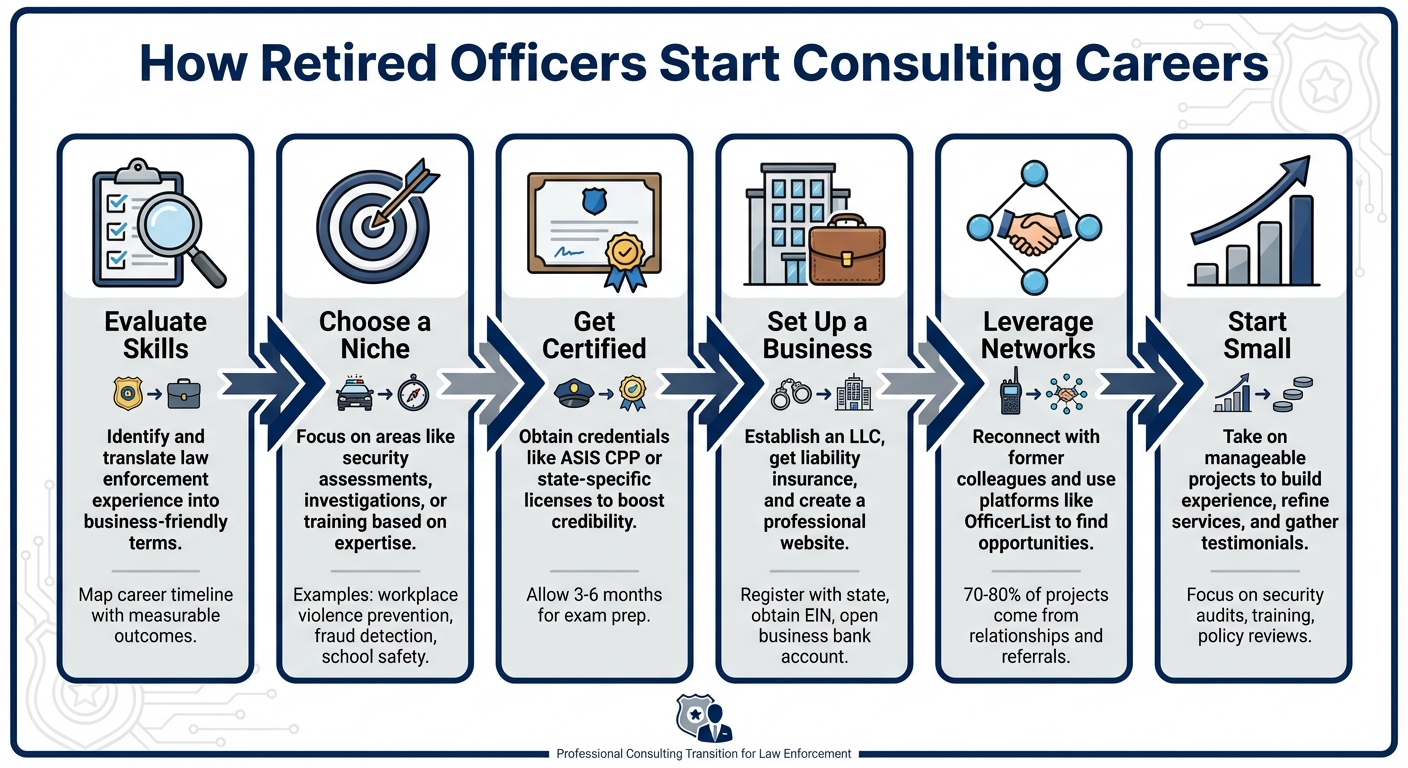
6-Step Guide for Retired Officers Starting Consulting Careers
Start by mapping out your career timeline, highlighting your roles, ranks, and units. For each position, list three to five key responsibilities along with measurable outcomes. For example: "Managed a 25-person unit; reduced response times by 18%" or "Conducted annual training for 250 officers; lowered use-of-force complaints by 25%."
Organize these achievements into categories like leadership, crisis management, risk assessment, investigations, training, and policy development. Next, translate law enforcement terminology into language that resonates with clients. Instead of saying "SWAT commander", describe it as "led a high-risk incident response team responsible for making critical decisions under pressure." Similarly, replace "developed SOPs" with "created and implemented standardized procedures that improved compliance and operational efficiency." This shift in language helps potential clients – who may not be familiar with law enforcement jargon – understand your value. Consulting firms like McKinsey and BCG actively seek out professionals with leadership, resilience, and problem-solving expertise, including those from military and law enforcement backgrounds.
Focus on outcomes and use terms that align with business priorities. Clients are interested in areas like safety, liability reduction, regulatory compliance, operational efficiency, and reputation management. To ensure your message is clear, test your revised language on professionals outside the law enforcement field, such as school administrators or business owners. Once you’ve clarified your skills and strengths, you’ll be better equipped to select a consulting niche that matches your expertise.
Using your refined skill set, choose a niche that aligns with your background and interests. For example, if you’ve led tactical teams or managed large-scale events, you could specialize in security risk assessments, workplace violence prevention programs, or critical incident readiness. Former detectives might excel in areas like corporate investigations, fraud detection, or internal misconduct reviews. School resource officers may find opportunities in school safety consulting, threat assessments, or training workshops, while command staff might focus on strategic planning, organizational assessments, or policy development.
Think about which aspects of your career energize you the most – whether it’s fieldwork, investigations, training, or community engagement. Consider whether you prefer hands-on assignments like security surveys or more analytical tasks like reviewing policies. Also, decide if you want to focus on local projects or take on remote opportunities. If you have a pension, it can provide financial flexibility, allowing you to prioritize projects that genuinely interest you instead of feeling pressured to accept every offer.
To confirm your niche, seek input from trusted colleagues or potential clients. Ask them which of your skills they value most and what challenges they would pay a consultant to address. Explore job postings on platforms like OfficerList – a marketplace tailored for active and retired law enforcement officers – to identify in-demand consulting roles and skills, such as security assessments, investigations, protective services, and training. Start small with a specific focus, like "help mid-sized school districts develop emergency response plans", and refine your approach based on feedback and experience.
Once you’ve chosen your niche, the next step is to back up your expertise with industry-recognized certifications. These credentials not only enhance your credibility but can also lead to higher-paying contracts. For those in corporate or physical security consulting, aim for the ASIS CPP (Certified Protection Professional) and PSP (Physical Security Professional) certifications. Earning these requires a mix of relevant experience, education, and passing a comprehensive exam.
If your focus is on training, use-of-force reviews, or policy consulting, ensure you maintain or acquire POST (Peace Officer Standards and Training) instructor credentials and firearms instructor certifications. Many states allow retired peace officers with these credentials to offer training to law enforcement agencies and private academies, often at better hourly rates than in-service trainers. For those specializing in investigations, fraud, or internal investigations consulting, the ASIS PCI (Professional Certified Investigator) is a strong choice, and you may also need a state private investigator license. Be prepared to dedicate three to six months to exam prep before officially launching your consulting business.
Once you’ve secured your certifications, it’s time to set up your business structure to protect your personal assets and simplify your tax responsibilities.
Your business structure plays a critical role in determining your liability protection and tax obligations. A single-member LLC is often a smart choice, offering liability protection while keeping things straightforward for taxes. Start by registering your business with your state, obtaining a free EIN (Employer Identification Number) from the IRS, and setting up a dedicated business bank account. Check if your state or locality requires a business license or professional license, such as a private security or investigator license.
Don’t overlook insurance. Consider investing in professional liability insurance (also known as errors and omissions insurance) and general liability insurance, especially if your work involves security consulting where clients may depend on your recommendations to address physical risks.
As your income grows, it’s worth consulting a CPA to explore electing S corporation status. This step could help reduce self-employment taxes while allowing you to pay yourself a reasonable salary.
With your certifications in hand and your business officially established, it’s time to create marketing materials that highlight your consulting expertise. Start with a consulting-focused résumé that translates your law enforcement background into business-friendly terms. Highlight skills like risk management, policy development, compliance, incident response, leadership, and project management.
Next, craft a one-page capabilities statement that outlines your core services – such as security assessments, workplace violence programs, policy audits, and training. Include your certifications (like CPP, PSP, or POST instructor credentials) and summarize past projects or cases (keeping them anonymous if needed).
Build a professional website that clearly communicates your niche, services, availability (local or remote), and contact details. Add a brief bio, your certifications, and testimonials as you collect them. Don’t forget to optimize your LinkedIn profile for consulting. Use a headline like "Security Consultant | Retired Police Captain | CPP, PSP", and write an "About" section that focuses on the problems you solve for businesses. List your certifications under "Licenses & Certifications" and post short insights on relevant topics to showcase your expertise. Platforms like OfficerList can also help you streamline your résumé and connect with potential clients, making it easier to build a steady pipeline of work opportunities.
With your business and marketing materials ready, the next step is to secure consulting opportunities.
Your network from law enforcement can be a goldmine for consulting work. Studies show that about 70–80% of projects come from existing relationships and referrals rather than cold applications. Start by listing 30–50 former colleagues – think chiefs, command staff, city risk managers, prosecutors, training coordinators, and corporate security contacts – who you worked with on joint task forces or interagency projects.
When reaching out, craft a concise, problem-focused message instead of directly asking for work. For example: "I’ve retired from the department and now focus on helping agencies strengthen use-of-force policies and training. I’d value your perspective on what challenges you’re seeing and whether this kind of support is useful". This positions you as a problem-solver who understands their needs. Reconnect through brief calls, coffee meetings, or by attending local police chiefs’ association events, regional training sessions, and retiree gatherings to announce your consulting practice.

OfficerList is a job platform designed exclusively for active and retired law enforcement professionals. It connects you with businesses and individuals seeking expertise in areas like consulting, security assessments, training, and specialized advisory roles. To stand out, build a detailed profile that showcases your consulting niche – whether it’s school safety, corporate investigations, emergency management, or dignitary protection. Include your years of service, rank, and certifications such as CPTED, threat assessment, emergency management, or ASIS CPP.
Your consulting résumé should focus on results. Instead of listing duties, use short, case-style bullets to highlight your impact. For example, describe how you led a cross-functional crisis response team for a 200-employee facility or implemented streamlined crisis response measures that improved efficiency. Set up job alerts for relevant categories and check the platform regularly to respond quickly to opportunities. Engaging with OfficerList’s community by answering questions or sharing best practices can also boost your visibility with potential clients.
In addition to leveraging your network and OfficerList, professional associations can help you broaden your reach. ASIS International, with over 34,000 members worldwide, is a great place to connect with corporate security directors, risk managers, and facility leaders. Join your local ASIS chapter, attend meetings, and volunteer on committees focused on areas like investigations, workplace violence, or critical infrastructure to showcase your expertise.
If you plan to consult with agencies on policy, training, or compliance, consider joining organizations like the International Association of Chiefs of Police (IACP), state chiefs’ associations, or the National Sheriffs’ Association. Larger conferences, such as the Global Security Exchange (GSX) or the IACP Annual Conference, offer excellent networking opportunities. Review the agenda and exhibitor list ahead of time, identify 10–15 target organizations, and prepare specific questions related to your consulting niche. After sessions, introduce yourself to speakers and panelists with a concise value statement, and follow up within 48 hours by offering a helpful resource and suggesting a brief call to turn introductions into leads.
Once you’ve got solid leads, it’s time to take the next step: building a consulting practice that not only delivers results but also establishes your reputation and creates a steady income stream.
When starting out, focus on smaller, clearly defined projects. For example, you might offer security audits for small businesses, schools, or churches; conduct one-time workplace violence or active-shooter awareness training; review policies for private security firms; or create incident-response plans for local nonprofits. These types of projects typically take just a few days or weeks, making them manageable while allowing you to build a portfolio of deliverables like reports, training outlines, and client testimonials.
For every project, draft a simple scope of work that outlines objectives, timelines, meeting schedules, and deliverables. Be realistic when estimating your time – factor in preparation, on-site work, analysis, and revisions. Use the project management skills you developed in law enforcement, such as checklists, after-action reviews, and regular progress updates, to maintain professionalism and refine your process. These early efforts set the stage for establishing competitive fees and delivering consistently high-quality results.
When it comes to pricing, you have three main options: hourly rates, project-based fees, or retainers.
To determine your rates, start with your financial goals. For example, if you aim to make $120,000 annually and estimate around 1,000 billable hours (considering time spent on non-billable tasks like marketing and admin), an hourly rate of about $120 makes sense. For project fees, account for all aspects of the work – preparation, delivery, travel, revisions – and add a 10–20% buffer for unexpected changes. As you gain experience and learn more about your market, revisit and adjust your rates to align with demand.
With your pricing in place, the focus shifts to delivering exceptional results that encourage repeat business. Start each project with a clear written proposal and a kickoff call. Throughout the project, maintain straightforward, jargon-free communication, and provide regular updates. When delivering reports, focus on actionable insights and business impacts.
Unlike law enforcement reports, which often cater to legal or internal audiences, private-sector clients prioritize concise, business-friendly recommendations. Avoid long narratives and excessive acronyms. Lead with key insights – similar to an executive summary – and connect your findings to tangible business outcomes like reputation, liability, safety, or insurance costs. Offer prioritized, step-by-step recommendations, including estimated costs and effort levels.
Timeliness and professionalism are crucial. Meet deadlines, respond to communications promptly, and conduct a quick "lessons learned" discussion after wrapping up each project. This helps build trust and sets the stage for future work. After finishing a project, ask for a testimonial and permission to reference your work (while respecting confidentiality). You can also request introductions to potential clients. Over time, compile your successes into case studies that highlight the client’s challenge, your approach, and the results achieved.
Finally, stay engaged with past clients. Schedule periodic check-ins to offer follow-up services like refresher training, policy updates, or new risk assessments. These touchpoints can turn one-time projects into lasting partnerships while helping you refine your offerings and pricing strategy.
Making the shift from law enforcement to consulting involves a clear plan: evaluate your skill set, choose a focus area, gain relevant certifications, establish your business, and tap into your network and specialized platforms. This step-by-step process allows you to build on the strengths you’ve developed over your career. Many retired officers have successfully transitioned into consulting by applying the same leadership, analytical thinking, and strategic planning skills they honed in the field.
Your pension offers a safety net, giving you the freedom to test different niches, take on smaller projects, and fine-tune your approach without the pressure of replacing your full income. Consulting then becomes a natural extension of the expertise you’ve spent years cultivating.
To get started, take actionable steps: draft a one-page list of your key skills, identify three types of clients you’d like to assist, and reconnect with at least one former colleague or business contact to discuss their current security or operational challenges. You can also create a profile on OfficerList, a platform designed to connect businesses with experienced law enforcement professionals. As Sergeant Jeffrey, a retired NYPD officer, noted:
"I was on the website looking for a part time job and found one within a week. I will highly recommend this website to all LEO’s."
Approach consulting as a business, not just a side gig. Your reputation, relationships, and consistent results will become the backbone of your success. Start small, focus on delivering value, and use each project to refine your services and expand your network. Over time, your niche, marketing materials, and pricing will naturally evolve based on real-world experience and client feedback.
The path is laid out, and the demand is there. Take that first step today.
Certifications are a powerful way to build credibility as a consultant. Retired officers might want to explore certifications in areas such as security management, crisis management, and project management (like PMP certification). Depending on their specific consulting niche, additional training in fields like risk assessment, leadership development, or cybersecurity could prove highly beneficial.
These credentials showcase expertise and help establish trust with potential clients, paving the way for a smoother transition into a thriving consulting career.
Retired officers have a wealth of experience that can translate seamlessly into consulting roles, thanks to skills like leadership, crisis management, communication, and problem-solving. The key is to present these abilities in a way that resonates with business audiences. For example, instead of simply stating your role, highlight measurable achievements: "Managed a team of 12 officers to enhance department efficiency" or "Implemented strategies that increased operational performance by 15%."
To ease the shift into consulting, consider obtaining certifications or completing training programs that align with your career goals. These credentials not only enhance your knowledge but also signal your commitment to potential clients or employers. Networking is equally important – connect with professionals in your desired industry and explore platforms specifically designed for retired law enforcement personnel.
By emphasizing your unique skill set and framing your past experiences in terms of tangible results, you can confidently position yourself as a valuable asset in the consulting world.
Starting a consulting career after retirement can be an exciting way to share your expertise and stay professionally active. Begin by assessing your skills and experience to pinpoint the areas where you can offer meaningful advice. If needed, consider pursuing certifications or additional training to strengthen your credentials and make your services more appealing.
Once you’re clear on your strengths, define your target audience and craft a detailed business plan to keep your efforts focused. Take care of the practicalities, like registering your business and meeting any legal requirements such as licenses or tax filings.
Networking is essential. Attend industry events, reconnect with former colleagues, and use platforms like OfficerList to discover opportunities specifically geared toward retired law enforcement professionals. Lastly, polish your resume to emphasize your specialized knowledge and promote your services through social media, professional platforms, and personal connections.