
If you’re looking to hire a police officer for security, here’s what you need to know:
Hiring off-duty officers offers expertise and legal authority that private security guards can’t match. However, ensure all arrangements are clear and compliant to avoid legal issues.
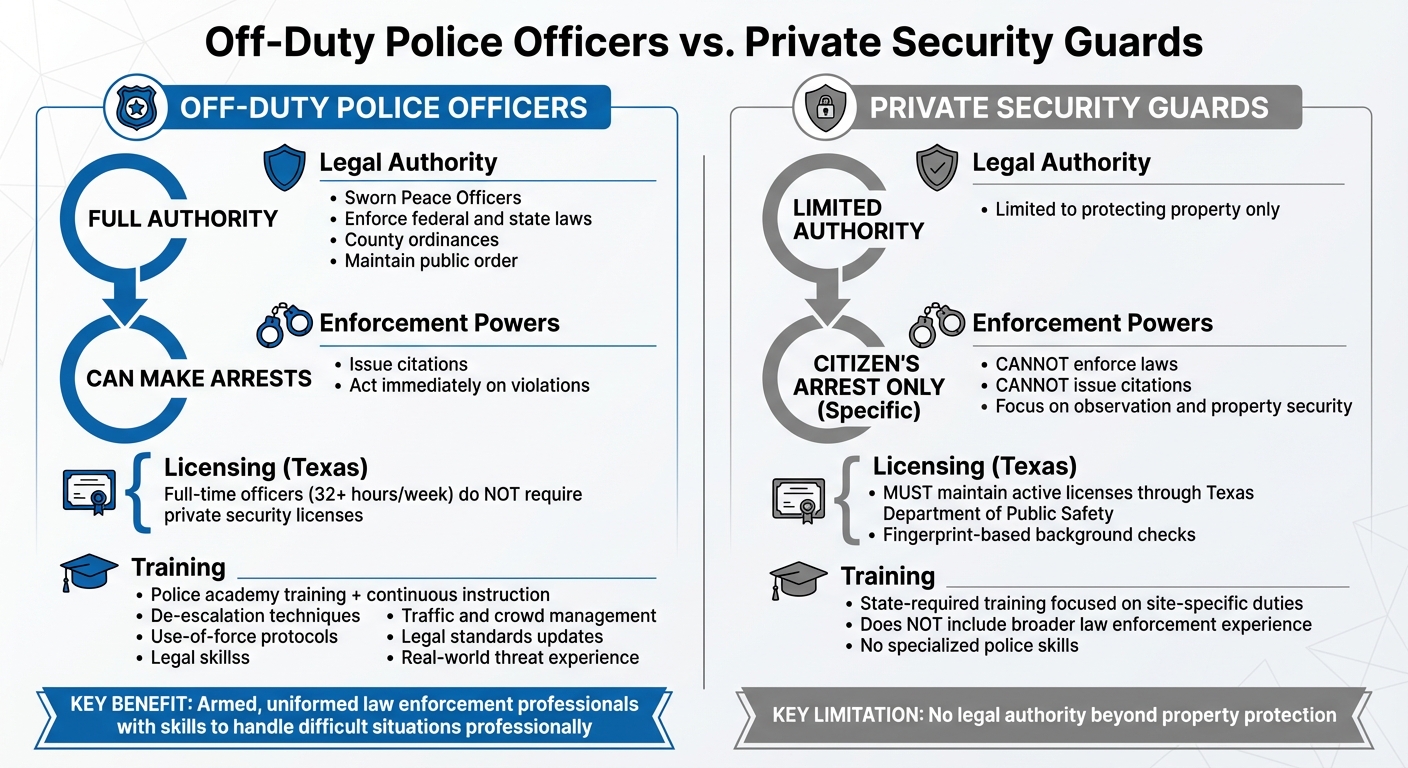
Off-Duty Police Officers vs Private Security Guards: Authority, Training & Legal Powers Comparison
When deciding between off-duty police officers and private security guards, it’s important to understand their differences in authority, training, and responsibilities. While both provide security, their roles and capabilities vary significantly, which can influence the level of protection they offer.
One of the key distinctions is their legal authority. Off-duty police officers are sworn Peace Officers, meaning they retain full authority to enforce federal and state laws, county ordinances, and maintain public order – even when working secondary jobs. The Travis County Sheriff’s Office describes their role clearly:
A TCSO Deputy’s primary responsibility while working in an off-duty status is the enforcement of federal and state laws and county ordinances; to protect life and property and to keep the peace.
This means off-duty officers can arrest, issue citations, and act immediately in response to legal violations. In contrast, private security guards are limited to protecting property and can only perform a citizen’s arrest in specific situations. They lack the authority to enforce laws or issue citations, focusing instead on observation and maintaining security within the property they are assigned to.
In Texas, peace officers working full-time (at least 32 hours per week) are not required to have private security licenses. On the other hand, private security guards must go through fingerprint-based background checks and maintain active licenses through the Texas Department of Public Safety. This distinction underscores the difference in their roles and the scope of their authority.
The training and experience required for these roles further highlight their differences. Police officers undergo extensive training at police academies, followed by continuous departmental instruction. Their preparation includes de-escalation techniques, use-of-force protocols, traffic and crowd management, and regular updates on legal standards. They also gain hands-on experience dealing with real-world threats and high-pressure scenarios.
Bonnie Lucas, CEO of Law Enforcement Specialists, Inc., explains the value of this expertise:
By hiring off-duty police officers you are guaranteed an armed, uniformed law enforcement professional with the skills to handle difficult situations in a professional manner.
Private security guards, while trained to meet state requirements, typically focus on site-specific duties. Their training does not encompass the broader law enforcement experience or the specialized skills that police officers bring to the table. This difference in preparation can significantly impact how each handles complex or high-stakes situations.
Start by clearly defining the scope of your security needs. Are you hiring for traffic control, managing crowds at a festival, or ensuring safety for a faith-based event? Identifying the type of assignment is crucial. You’ll also need to gather key event details like the date, hours, location, expected number of attendees, and whether alcohol will be served.
Before moving forward, check which types of assignments are restricted. For example, many police departments prohibit officers from working as personal bodyguards, serving legal documents, or providing security at venues with permanent alcohol licenses, such as bars and clubs. Additionally, ensure any required permits are submitted at least 14 days before the event.
Once you’ve outlined your requirements, you can begin searching for qualified officers.
To find officers for your security needs, consider reaching out to local police departments’ Off-Duty Work Details. Many departments have dedicated coordinators who help businesses connect with officers, negotiate pay, and ensure the officers meet the job requirements. As the Phoenix Police Department advises:
"Contacting the Off-Duty Work Detail is the best way to determine if an off-duty officer is right for your specific situation."
For urgent needs during evenings or weekends, the department’s main information desk can often assist.
Another option is to work with licensed security companies that specialize in off-duty law enforcement or use job marketplaces like OfficerList. These platforms connect businesses with active and retired officers. When using such services, look for "Verified LEO" badges, which confirm that the candidate’s law enforcement credentials have been thoroughly vetted.
Once you’ve identified potential candidates, it’s time to verify their qualifications and formalize the arrangement. Perform background checks and screenings to ensure the officer is a good fit for your specific security needs. In states like California, you can use online "Verify a License" tools to confirm that the officer is registered with the state bureau. Additionally, check that they have any required permits, such as those for carrying firearms or batons.
Discuss and finalize payment terms with the officer or their coordinator. Decide whether the officer will be paid hourly or at a flat rate, and clarify uniform requirements – will they wear their official department uniform or plain clothes? .
Draft a written agreement that outlines all key details, including job responsibilities, hours, payment terms, and the officer’s authority during the assignment. Keep in mind that while officers are responsible for upholding local, state, and federal laws, they cannot enforce private employer rules unless those rules intersect with the law. Lastly, ensure you have adequate commercial general liability insurance, as most departments offer only limited coverage for law enforcement actions taken during off-duty assignments.
If you’re running a security service in California, securing a Private Patrol Operator (PPO) license is a must. This involves passing an exam, undergoing a criminal history check, and appointing a Qualified Manager with the necessary experience.
Additionally, businesses must maintain a Certificate of Liability Insurance with a minimum coverage of $1,000,000 per occurrence. When reviewing this certificate, ensure it includes the company’s name, policy number, and current coverage dates. If you’re hiring an unarmed officer directly for your organization, they need to register as a Proprietary Private Security Officer (PSO). Before starting, they must complete at least 8 hours of training on "Power to Arrest" and "Appropriate Use of Force".
For armed officers, a separate Bureau-issued firearm permit is required. This permit involves 14 hours of training and biennial requalification. Officers wishing to carry a concealed weapon must also obtain a Concealed Weapons Permit (CCW) from their local authority.
Private security operations are governed by a mix of federal, state, and local regulations. At the federal level, fingerprint-based criminal history checks are mandatory for private security officers. Employers must certify compliance with their state agency, obtain written consent from employees, and securely store these records.
State laws can vary significantly. For example, in Texas, full-time peace officers working over 32 hours per week can provide security services without needing a private security license, as long as they receive standard benefits and minimum wage. However, this exemption is limited to specific roles like guard, patrol, or watchman duties and doesn’t extend to services such as private investigations. Some states have chosen to "opt out" of the federal background check system through specific laws, so it’s essential to confirm your state’s participation status before moving forward.
Failing to comply with these regulations can lead to severe consequences. Misusing criminal history information, for instance, carries penalties of up to two years in prison, fines, and the loss of "authorized employer" status. The Bureau of Security and Investigative Services underscores this priority:
Protection of the public shall be the highest priority for the Bureau of Security and Investigative Services in exercising licensing, regulatory and disciplinary functions.
Be sure to retain employee consent forms for background checks for at least three years from their last use.
Assign a single coordinator to manage all communication, scheduling, and staffing needs. This person will act as the primary liaison, ensuring specific assignment details are addressed and maintaining a solid working relationship between your business and the hired officers. The Phoenix Police Department underscores the importance of this connection:
The intent is to have a positive relationship between your business, the Phoenix Police Department and the public.
Be thorough when sharing event details – include dates, hours, location, expected attendance, and whether alcohol will be served. Clear communication helps officers consistently exercise their law enforcement authority during the assignment.
It’s also crucial to confirm roles and responsibilities upfront. Both parties should agree on the actual hours worked, including any early arrivals or extended service.
Everyone involved must understand the officers’ scope of authority. Officers are there to enforce local, state, and federal laws, not private company policies. As noted by the Phoenix Police Department:
Officers are not to enforce the rules and regulations of a private employer as a condition of their employment… unless there is a violation of local, state or federal law.
Typically, officers wear their department-issued uniforms during private assignments unless they’ve obtained written permission to work in plainclothes. If you require marked patrol vehicles, coordinate this request in advance through your designated contact – keep in mind, this usually comes with additional costs.
Additionally, ensure your business has adequate commercial liability insurance to cover incidents involving off-duty officers. Municipal liability coverage generally applies only to official law enforcement duties.
Once equipment and legal compliance are squared away, shift focus to maintaining service quality.
Off-duty officers are expected to uphold the same level of professionalism as they do while on duty. To maintain transparency and ensure accurate billing, request regular updates from your coordinator, such as quarterly summaries of hours worked. If the service doesn’t meet expectations, you should have the option to request a new coordinator or different officers.
For ongoing accountability, require periodic performance reports. Active-duty officers should provide an annual signed VE-PEC (Verification of Employment – Police Experience/Certification) form. For retired officers, confirm they possess valid, up-to-date state credentials. This helps ensure all personnel meet the necessary standards for their roles.
Bringing a police officer on board for security involves more than just hiring someone with a badge. It requires careful attention to legal requirements, securing proper liability insurance, and establishing clear agreements regarding payment and responsibilities.
Start by outlining your specific security needs – include details like dates, hours, location, and estimated attendance. Coordinate through an official liaison to manage scheduling and maintain accountability. This ensures the process runs smoothly and upholds professional standards. As the Phoenix Police Department emphasizes:
"The officers you hire are expected to provide you with the same level of service they would provide the public while in an on-duty capacity."
The key distinctions between hiring off-duty police officers and private security guards come down to their training, legal authority, and responsibilities.
Off-duty police officers complete rigorous law enforcement training, which often spans several months. They maintain legal powers such as making arrests and conducting investigations, even while working off duty. Plus, their on-the-job experience equips them to handle complex and high-pressure security situations effectively.
Private security guards, however, typically go through shorter training programs and have limited legal authority. Their primary duties involve observing, reporting, and serving as a visible deterrent. While both off-duty officers and private security guards can provide protection, off-duty officers are generally better equipped for high-risk or sensitive scenarios due to their expertise and legal capabilities.
When hiring, make sure to follow all applicable state and local regulations to ensure compliance with laws governing private security work.
To hire off-duty police officers for security work, it’s crucial to navigate state and local regulations carefully. First, confirm that the officers you’re considering are permitted to provide private security services in your area. In some states, full-time officers can take on off-duty security roles without needing extra licensing, but certain conditions – like minimum hours or specific wage standards – often apply.
It’s also important to coordinate with the appropriate law enforcement agency. Many agencies have policies requiring formal requests or the use of designated off-duty programs. These programs often involve requirements like carrying liability insurance and following established protocols. Lastly, make sure to review your state’s private security employment laws to avoid legal issues or liabilities. By understanding these rules and collaborating with law enforcement, you can ensure the hiring process is both smooth and compliant.
To verify the credentials of an off-duty police officer, start by checking their employment status with the local law enforcement agency they’re affiliated with. This step confirms they are actively employed and in good standing.
Next, ensure they hold the necessary licenses or certifications for private security work in your state. You can typically confirm this through your state’s security licensing boards or relevant agencies.
It’s also a good idea to run a criminal background check through authorized organizations to confirm they meet all legal and professional standards. Be sure to follow all state and federal regulations during the verification process to stay compliant and ensure you’re making a reliable hire.