
If you want the short answer: most event security managers in the U.S. earn about $45,000 to $75,000 a year in 2026, with many jobs landing near $62,700. Pay moves higher in big event markets, large venues, and jobs with more scope. It can also jump with overtime, per-event pay, and backgrounds in law enforcement or military leadership, or advanced security credentials.
Here’s the core takeaway in plain English:
What stands out most is simple: event security manager pay sits above front-line event security work but below broad security manager jobs. That gap comes from scope. Event-focused roles center on crowd flow, staffing, access points, and event-day incident response, while broader security manager jobs often cover company-wide risk, budgets, and compliance.
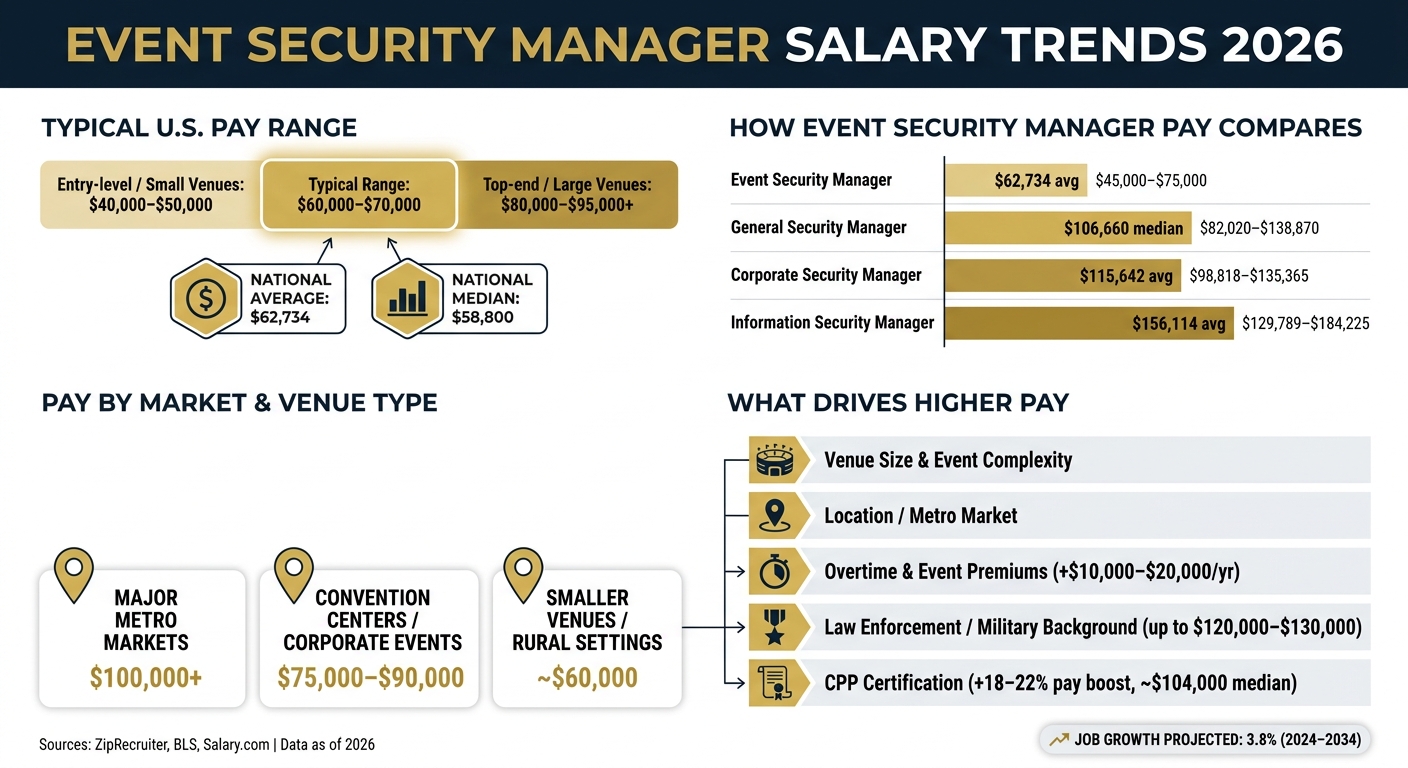
Event Security Manager Salary Breakdown 2026
| Role | Typical Pay |
|---|---|
| Event Security Manager | $45,000–$75,000 |
| Upper-end Event Security Manager | $80,000–$95,000+ |
| Senior metro event-security roles | $100,000+ |
| General Security Manager | $106,660 median |
If I boil the full article down to one line, it’s this: the more people, pressure, hours, and risk you manage, the more you can expect to earn.
In 2026, most event security managers in the U.S. earn $45,000 to $75,000 a year. ZipRecruiter’s full-time job postings put the national average at $62,734 annually, with a median near $58,800.
Base pay usually lands in three main tiers. Smaller venues and entry-level manager roles tend to fall between $40,000 and $50,000. More common roles sit around $60,000 to $70,000. At the top end, large venues, multi-site operations, and premium markets can pay $80,000 to $95,000+.
That’s just base pay. Once overtime and event premiums get added in, total earnings can climb quite a bit.
Event security manager pay is lower than general security manager pay for a simple reason: the role usually covers a narrower slice of the job.
Across corporate, industrial, and facility settings, general security manager roles show a national median of $106,660 per year, and the middle half of earners make between $82,020 and $138,870. Salary.com also lists an average security manager salary of $114,192, with a common range of $81,932 to $151,317.
Why the gap? General security manager roles often handle broader risk, compliance, and enterprise-level security work. Event security managers are focused more on live operations, crowd control, staffing, access points, and event-day incident response.
| Role Type | Benchmark | Typical Range | Primary Data Source |
|---|---|---|---|
| Event Security Manager | About $62,734 average; $58,800 median | $45,000–$75,000 | ZipRecruiter job postings |
| General Security Manager (all industries) | $106,660 median | $82,020–$138,870 | BLS-based synthesis |
| Corporate Security Manager | $115,642 average | $98,818–$135,365 | Salary.com |
| Information Security Manager | $156,114 average | $129,789–$184,225 | Salary.com |
Those numbers start to shift once overtime and event-heavy schedules come into play.
Pay can be structured as salary or hourly wages. Large venues, sports franchises, and convention centers often put managers on salary. Hourly pay is more common with contract security firms and entertainment companies.
For closely related event security supervisor postings, ZipRecruiter shows a usual hourly range of $18.27 to $29.33, with an average of $25.98 per hour as of May 2026.
At $28 to $30 per hour on a standard 40-hour week, annual base pay comes out to about $58,000 to $62,000. That lines up closely with the national average from job ads.
Of course, event work rarely fits into a neat 40-hour schedule. Managers handling large festivals, pro sports seasons, or busy convention calendars often work 50 to 60 hours per week during peak stretches. For non-exempt hourly managers, time-and-a-half kicks in after 40 hours. During busy periods, that overtime can add $10,000 to $20,000 or more to annual earnings.
Salaried managers who are classified as exempt may not get overtime pay directly. Instead, employers often make up for those extra demands with per-event bonuses or stipends, especially for high-revenue or high-risk events.
Pay rises further in major event markets and higher-cost regions.
Base pay only tells part of the story. Event type and location drive some of the biggest pay swings, and the national average can blur those gaps.
In plain terms, bigger and harder jobs tend to pay more. Large stadiums and arenas often outpay conventions, corporate events, and small venues. When the assignment gets more complicated, pay can climb even further. That includes work like large festival planning or coordinating across multiple jurisdictions.
You see the same pattern across the U.S. too. In major markets, employers often pay more for the same job title than they do in smaller cities or less busy areas.
Regional pay can vary a lot. Senior event-security roles in large metro markets often go past $100,000, while smaller venues or rural settings tend to sit much closer to $60,000.
| Market / venue type | Typical pay | Pay signal |
|---|---|---|
| Major metropolitan event markets | $100,000+ | Often six figures. |
| Convention centers and corporate events | $75,000–$90,000 | Mid-range band. |
| Smaller venues or rural settings | Around $60,000 | Lower starting pay. |
That gap comes down to a few simple factors: event complexity, market size, and regional labor costs.
Guard turnover is still a big factor. Employers are competing for experienced supervisors, and that pushes pay up for managers who can keep event operations running without things falling apart. When there are fewer qualified people who can lead a team, handle pressure, and make good calls on the spot, wages tend to climb.
You can see that in the numbers. Average hourly guard pay increased from about $18.45 in late 2023 to $20.08 by the end of 2025. At the management level, security manager salaries are up 8% over the last five years, including a 4.2% increase from 2024 to 2025 alone.
Event security managers also do far more than basic supervision. They work with local law enforcement, manage crowd flow, oversee access-control systems, and prepare contingency plans for emergency situations. That kind of job carries more pressure and more responsibility, so it pays more than standard security supervision.
Pay is also shaped by the person filling the role. For senior event security jobs, employers often want candidates with prior law enforcement or military leadership experience. That preference shows up clearly in hiring posts. A Chicago security director role posted by Silent Professionals, for example, offered $120,000–$130,000 per year and asked for strong ties to the local police department, along with deep law enforcement or corporate security experience.
Certifications can move pay higher too. CPP (Certified Protection Professional) holders earn about 18%–22% more than non-certified peers, with median earnings near $104,000 versus $86,000 for those without the credential. For event security managers, that signals they can handle risk, access control, and incident planning for large venues.

These qualifications matter because employers are still looking for people with this background. BLS projects employment for security managers to grow 3.8% over 2024–2034. That tracks with what venues and event organizers are dealing with: tighter safety rules, more scrutiny, and more liability if something goes wrong.
For employers trying to fill these roles, OfficerList is part of the picture. OfficerList connects active and retired law enforcement officers with employers hiring for event security and management roles.
The data points to three main drivers of event security manager pay in 2026: market, venue size, and role scope. Event security managers land in the middle of the pay ladder. National pay centers around $62,700, which puts the role above front-line event security jobs but below the broader security-manager median of $106,660. As venue size, event complexity, and job scope grow, pay tends to move up with them.
Location also has a big effect on earnings. Washington and New York rank near the top, while lower-cost markets can pay more than $70,000 less. That gap is hard to ignore. Places with heavy event traffic – major arenas, convention centers, and entertainment hubs – often push pay toward the top of the range, and sometimes past it.
The type of event matters too. Managers responsible for stadiums, large concerts, or multi-day festivals are more likely to earn near the top of the event-security pay band. Smaller events, or those with less risk, usually pay less.
Background and credentials can also move the needle. Higher pay often lines up with law enforcement or military experience, incident-command work, and crowd-management or emergency-response credentials. Put simply: more responsibility, more risk, more pay.
For people aiming to move up, the clearest path is to focus on high-volume markets, build crowd-control and emergency-response skills, and go after roles with broader scope.
Industry-recognized security credentials often lift pay faster because they show two things at once: leadership ability and deep subject knowledge.
For event security managers, ASIS certifications like CPP and PSP can strengthen credibility and help open the door to higher-paying leadership jobs. If you’re earlier in your career, an entry-level credential like CPO can help too. And if you add more advanced knowledge, such as cybersecurity through CISSP, your earning potential can go up as well.
The sources available here don’t name the specific cities that pay event security managers the highest salaries.
That said, in the private sector, pay usually falls between $85,000 and $130,000. Where someone lands in that range often comes down to a few things: location, the employer’s industry, and how much the role covers day to day.
Yes – event security management can be a strong long-term career.
OfficerList says these roles can suit people who are good at handling emergencies and assessing threats. The pay can also be solid, with earnings of about $85,000–$130,000 depending on location and job scope.
There’s also steady demand for this kind of work, especially as physical and digital security start to overlap more often. That mix matters now. A live event isn’t just about doors, barriers, and crowd control anymore. It can also involve access systems, surveillance tools, and cyber risk.
For many people, that opens the door to career growth beyond day-to-day event coverage. Over time, it can lead to roles in supervision, security operations, or risk-management leadership.