
Hiring off-duty police officers for security, events, or traffic management involves several factors that impact costs. Rates vary by location, rank, and assignment type. Here’s a quick breakdown:
Planning ahead (at least two weeks) helps secure availability and manage costs. Total expenses depend on the officer’s role, risk level, and location. For streamlined hiring, platforms like OfficerList can simplify the process.
Cost Breakdown for Hiring Off-Duty Police Officers by Location and Rank
Understanding the key factors that influence the cost of hiring an officer is crucial for creating an accurate budget. Typically, the total expense breaks down into three main categories: the officer’s hourly rate, administrative fees, and equipment-related expenses.
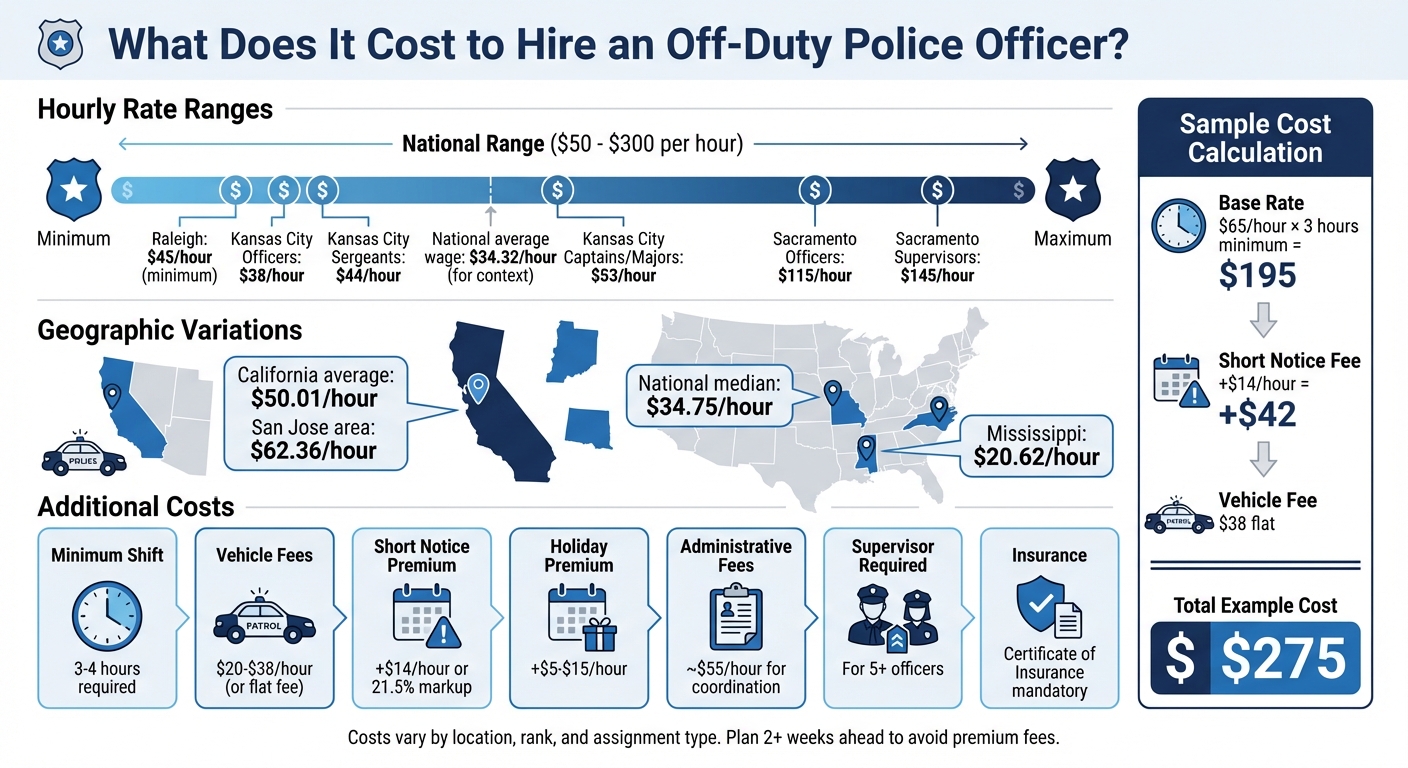
The national average hourly wage for police and sheriff’s patrol officers is $34.32. However, off-duty rates are often much higher, ranging from $50 to over $300 per hour, depending on jurisdiction, rank, and the level of risk involved.
Geography plays a big role in determining rates. For example, California leads with an average hourly wage of $50.01, and the San Jose-Sunnyvale-Santa Clara area tops the charts at $62.36 per hour. In Kansas City, minimum rates are set at $38 per hour for officers, $44 for sergeants, and $53 for captains and majors. Raleigh follows a similar pattern with its minimum rates.
Rank makes a difference. Supervisors, such as sergeants, command higher rates than patrol officers. Some assignments may even require a higher-ranking officer. As noted by Law Enforcement Specialists, Inc.:
Pricing for hiring off-duty police officers depends on factors such as how long an officer is needed, location of the request, jurisdiction, agency, as well as other variables such as rank of officer needed, the type of service requested, and level of risk involved.
Demand often outstrips supply. According to the Kansas City Missouri Police Department:
Officers decide to engage in secondary employment voluntarily and aren’t obliged to do so regardless of the offered pay rate.
This shortage means employers sometimes offer rates above the department’s minimum to secure personnel.
Beyond the base pay, administrative fees also contribute significantly to the overall cost.
In addition to the officer’s hourly rate, you’ll encounter administrative fees. For instance, in Travis County, Texas, a Peace Officer Contract Coordinator may charge $55 per hour to handle scheduling, invoicing, and communication with the agency.
Last-minute requests cost more. If you need to book an officer on short notice (typically less than 48–72 hours), expect a 21.5% markup. Holiday assignments also come with an extra charge, usually between $5 and $15 per hour.
Cancellation policies are another factor to consider. Most agencies require at least 72 hours’ notice for cancellations. If you cancel too late, you’ll likely be billed for the minimum shift – typically three to four hours per officer.
On top of pay and administrative fees, equipment and insurance requirements can add to your expenses. Officers generally work in their standard uniforms with their usual gear, but vehicle costs can vary. Some departments include patrol cars at no extra charge, while others bill separately. For example, Travis County charges about $20 per hour for vehicle use, often requiring a two-hour minimum. Similarly, the City of Raleigh sends a separate invoice for vehicle usage directly to the employer.
Insurance is non-negotiable. Most departments require you to provide a Certificate of Insurance (COI) to cover liability during the assignment. As Gordon Graham, Co-founder of Lexipol, explains:
A dollar properly spent on a background check can save you a million dollars in lawsuits.
Lastly, payments are typically processed through checks or the agency’s invoicing system – cash payments are not accepted. Be sure to account for these administrative and logistical requirements in your planning.
To get a clear picture of total expenses, you need to define your needs, calculate applicable fees, and organize everything into a detailed breakdown. Once you’ve identified your security requirements, you can work through base rates and additional factors to finalize your budget.
Start by clearly outlining the role you need. The type of security service – whether it’s personal protection, event security, or safeguarding corporate property – will influence both the skill set required and the base cost. For example, a one-hour ribbon-cutting ceremony will demand less planning and expertise than a week-long executive protection detail.
The risk level is another critical factor. High-profile individuals or potentially controversial events often require personnel with advanced training or military experience. If there’s a heightened risk of threats, expect to pay more for officers with tactical expertise.
The setting and industry also play a role. Security needs differ between locations like schools, government buildings, or corporate offices, each requiring specific training and legal authority. For instance, an officer managing traffic at a school event will have different qualifications than someone providing executive protection at a corporate headquarters. You’ll also need to decide if you require services like active patrol, traffic direction, accident investigation, or suspect apprehension – this helps determine the appropriate level of law enforcement.
Once you’ve defined the role, calculate the costs based on hourly rates and additional fees. Keep in mind that many jurisdictions enforce minimum shift durations, typically three to four hours.
Short-notice requests (less than 72 hours) come with added costs – often ~$14 per hour or more. For instance, in Parker, Colorado, the base rate of $65 per hour increases to $79 for short-notice assignments. Similarly, holiday shifts tend to carry higher rates, averaging around $75 per hour.
For larger events, supervisory ratios come into play. If you need five or more officers, you may also need to hire a supervisor at a higher rate. In Sacramento, California, sergeants cost $145 per hour, compared to $115 for regular officers. Vehicle fees can vary as well. While some departments include marked vehicles at no additional cost, others, like Sacramento, charge a flat $38 fee per vehicle.
To organize your budget, break down all costs into a clear table. This helps you calculate daily, weekly, or monthly expenses and pinpoint any budget gaps.
| Cost Component | Your Calculation | Example |
|---|---|---|
| Base Hourly Rate | Officer rate × minimum hours | $65 × 3 hours = $195 |
| Premium Multipliers | Short notice, holiday, or high-risk fees | +$14/hr for <72 hrs notice |
| Supervisor (if needed) | Supervisor rate × hours | $145 × 3 hours = $435 |
| Vehicle Fee | Per vehicle or per hour | $38 flat fee |
| Insurance | Certificate of Insurance requirement | Verify with department |
Don’t forget to adjust for geographic differences. For example, the mean hourly wage for patrol officers ranges from $21.73 at the 10th percentile to $53.70 at the 90th percentile nationwide. California’s mean hourly wage is $53.74, with San Jose leading at $67.07. Use these benchmarks to refine your estimates based on your location.
If your assignment involves overnight stays or international travel, add those costs to your breakdown. Additionally, factor in equipment expenses – if the security personnel need to provide communication devices, surveillance tools, or specialized gear, these costs can add up quickly.
When estimating costs, several factors can shape the final numbers. Knowing what influences these variables can help you better prepare your budget and anticipate expenses.
Where you are matters – a lot. Geographic location can drastically affect hourly wages. For example, as of May 2023, California tops the charts with patrol officers earning an average of $53.74 per hour, while Mississippi lags behind at $20.62 per hour. Urban areas often push these rates even higher. In the San Jose-Sunnyvale-Santa Clara region, officers average $67.07 per hour, nearly triple the $22.79 rate in Kansas nonmetropolitan areas. Other high-paying metro areas include San Francisco-Oakland-Hayward at $61.63 and New York-Newark-Jersey City at $46.91, compared to the national average of $36.80. These differences stem from factors like local cost-of-living and labor market competition. Even federal and court systems adjust pay based on geography, using "Locality Pay" percentages to account for regional disparities.
An officer’s level of experience and expertise plays a big role in pricing. For instance, wages vary significantly between entry-level and seasoned officers. Those in the 90th percentile earn $53.70 per hour, while those in the 10th percentile make just $21.73 – a $31.97 difference. Rank also impacts costs. In June 2025, the Raleigh Police Department introduced a policy requiring a minimum of $45 per hour for off-duty officers, with supervisors commanding higher rates for certain jobs. Specialized skills can drive up costs too. Officers working in fields like air transportation support average $38.63 per hour, compared to $36.89 for general local government roles. Meanwhile, assignments requiring advanced training, such as cybersecurity, can range from $75 to $200 per hour depending on the complexity. These variations highlight how specific skills and experience affect pricing.
The nature and length of an assignment can also influence costs. Standard event security typically costs $20 to $30 per hour, but high-risk or last-minute assignments – with added fees for supervision and equipment – can spike rates to $50–$100+ per hour. Larger events often require supervisory personnel, which raises costs further. Additionally, many assignments have minimum shift requirements that impact the overall cost, even for short-term jobs. Planning ahead can help manage expenses – providing two to four weeks’ notice can help you avoid premium charges for emergency requests.
How you hire – contractor or employee – also shapes costs. Hiring an off-duty officer as an independent contractor usually involves an hourly rate and minimum shift requirements. For example, Raleigh mandates a $45 per hour rate with a three-hour minimum ($135 total), while Sacramento requires $115 per hour with a four-hour minimum ($460 total). On the other hand, full-time employment comes with different expenses. State government officers earn an average of $39.54 per hour, slightly higher than the $36.89 for local government officers. Full-time roles also include additional costs like benefits, training, equipment, insurance, and administrative overhead, which are typically rolled into departmental budgets. Contractors provide flexibility for short-term needs, whereas full-time employees are better suited for ongoing security requirements where consistent availability and integration are key. Choosing the right model for your situation can help you optimize costs.
When setting up your budget, start by referencing national salary averages. For example, the median hourly rate for officers stands at $34.75. However, this can vary widely based on location. In higher-cost areas like San Jose, California, rates can climb to $62.36 per hour, while in more affordable regions, you might see rates between $20 and $25 per hour.
Don’t forget to factor in additional costs. Add at least 25% to account for benefits and administrative overhead. For instance, if you’re budgeting $35 per hour for an officer, you should plan for a total cost of $43.75 per hour. Federal programs like the COPS Hiring Program can help ease some of this financial burden. This program covers up to 75% of entry-level salaries and benefits, with a cap of $125,000 per officer over three years. However, you’ll still need to budget for the 25% local cash match.
To keep everything organized, list all your costs – base pay, benefits, equipment, and fees – in a simple table. Once your budget is clear, you’ll be ready to explore tools that make hiring more efficient.
After finalizing your budget, simplify your hiring process with OfficerList, a platform built specifically for law enforcement recruitment. OfficerList connects employers with skilled law enforcement professionals, eliminating many of the headaches associated with traditional hiring. Forget about navigating complex municipal procedures or dealing with lengthy internal recruitment processes. Instead, post your job openings and receive applications from qualified candidates who already have industry-specific resumes prepared.
OfficerList also offers transparent pricing tailored to your needs. You decide the role’s requirements, location, and duration, and the platform matches you with officers whose qualifications align with your budget. This streamlined approach not only keeps hiring costs under control but also saves time by automating repetitive tasks like sorting through unqualified applicants or coordinating with multiple agencies. With OfficerList’s tools, you can focus on finding the best candidate without getting bogged down in paperwork.
Every hiring method has its own costs and challenges. Here’s a quick comparison of how they measure up:
| Feature | Direct Hiring | Municipal Off-Duty Programs | OfficerList |
|---|---|---|---|
| Cost Transparency | Often buried in general budgets | Complex due to varying local rules | Clear, upfront pricing based on your needs |
| Administrative Overhead | High; requires HR staff and recruiter salaries | Variable; depends on local agency processes | Low; automation reduces manual work |
| Candidate Pool | Limited to internal outreach and referrals | Restricted to local agency officers | Broad access to professionals across regions |
| Processing Speed | Slow due to manual screening | Delayed by municipal procedures | Faster with tech-enabled screening |
Direct hiring allows for full control but demands significant internal resources. Municipal off-duty programs are great for routine local needs but can be inflexible. OfficerList strikes a balance, offering access to a wider pool of candidates while cutting down on administrative time and providing clear, upfront cost structures.
Bringing a police officer onto your team involves more than just covering their base salary. You’ll need to factor in fringe benefits like health insurance, retirement plans, and disability coverage. On top of that, training costs can climb to as much as $100,000 per officer. Costs also vary significantly depending on where you’re located, with the national median hourly wage at $34.75. However, your total expenses will ultimately depend on your specific needs and local market conditions. Breaking down these costs is key to effective budget planning.
When planning your budget, make sure to include base pay, benefits, equipment, and administrative fees. If federal assistance is an option, programs like the COPS Hiring Program can cover up to 75% of entry-level salaries and benefits. Keep in mind, though, that a 25% local cash match is often required.
OfficerList makes this process easier by connecting you directly with qualified law enforcement professionals. The platform offers a transparent and efficient way to manage costs. You can post your requirements and receive applications that align with your budget – without dealing with unnecessary complications. This streamlined approach not only reduces administrative tasks but also speeds up hiring, helping you focus on finding the right officer for your team.
The cost of hiring an off-duty police officer can differ widely based on location and the officer’s rank. Rates are usually determined by the local police department and depend on factors like union agreements, cost-of-living adjustments, and administrative fees. For instance, cities such as New York and Raleigh have established hourly rates and minimum shift requirements, reflecting their local budgets and regional economic conditions.
An officer’s rank significantly influences the price. Higher-ranking officers, like sergeants or lieutenants, often charge more due to their experience and leadership responsibilities. In New York City, for example, off-duty officer rates start at $37 per hour for a police officer and go up to $52 per hour for a lieutenant, not including administrative fees.
If you’re planning a budget, begin by reviewing the base rates set by your local department and factor in the officer’s rank. In many areas, hourly costs for off-duty officers typically fall between $55 and $100 or more, especially for senior officers or assignments requiring specialized skills.
When bringing off-duty police officers on board, it’s important to be aware that the expenses can extend beyond their hourly pay. You might face administrative fees, such as a 10% surcharge that some departments require. Additionally, there are often mandatory costs like workers’ compensation coverage, liability insurance premiums, and sometimes background check or pre-payment fees.
These extra charges can differ based on your location and the specific hiring requirements. Make sure to account for these in your budget to avoid surprises and ensure the process runs smoothly and meets all necessary regulations.
The cost of hiring off-duty police officers can vary based on several factors, including hourly rates, the number of officers required, total hours worked, and any extra fees. Hourly rates typically fall between $55 and $100+ per hour, depending on the location and the officer’s rank. For instance, a patrol officer might charge around $67.50 per hour, while higher-ranking officers, such as sergeants or lieutenants, often charge more. Additionally, some areas may include administrative fees or vehicle-related charges.
To calculate the total expense, multiply the officer’s hourly rate by the number of hours worked and factor in any additional fees. Keep in mind that many agencies enforce minimum hourly requirements, often three or four hours. For example, hiring two officers for a 5-hour event, along with a patrol car, might cost approximately $775, though this will depend on local rates and specific charges.
By reviewing the rates and policies in your area, you can create an accurate budget for hiring off-duty police officers for your event.