
If I retired from law enforcement in 2026, I’d look hard at corporate security. Pay is often much higher than front-line guard work, boards now treat security as part of business risk, and employers need people who can run investigations, threat assessment, workplace violence programs, GSOCs, and executive protection.
Here’s the short version:
| Area | What’s changing | What it means for a retired officer |
|---|---|---|
| Security leadership | Security is now tied to business risk and continuity | Leadership and briefing experience matter more |
| Pay | Management roles sit far above guard pay | Target manager, investigator, GSOC, or director tracks |
| Tech | More AI video, shared alerting, and GSOCs | Learn the systems, not just field response |
| Compliance | More workplace violence rules and board oversight | Threat assessment and investigation work grows |
| Hiring fit | Companies want people who can handle hard incidents | Police skills transfer well if framed in business terms |
I’d sum it up like this: retired officers have a direct path into corporate security, but the best jobs go to people who can explain their experience in plain business language and close a few skill gaps fast.
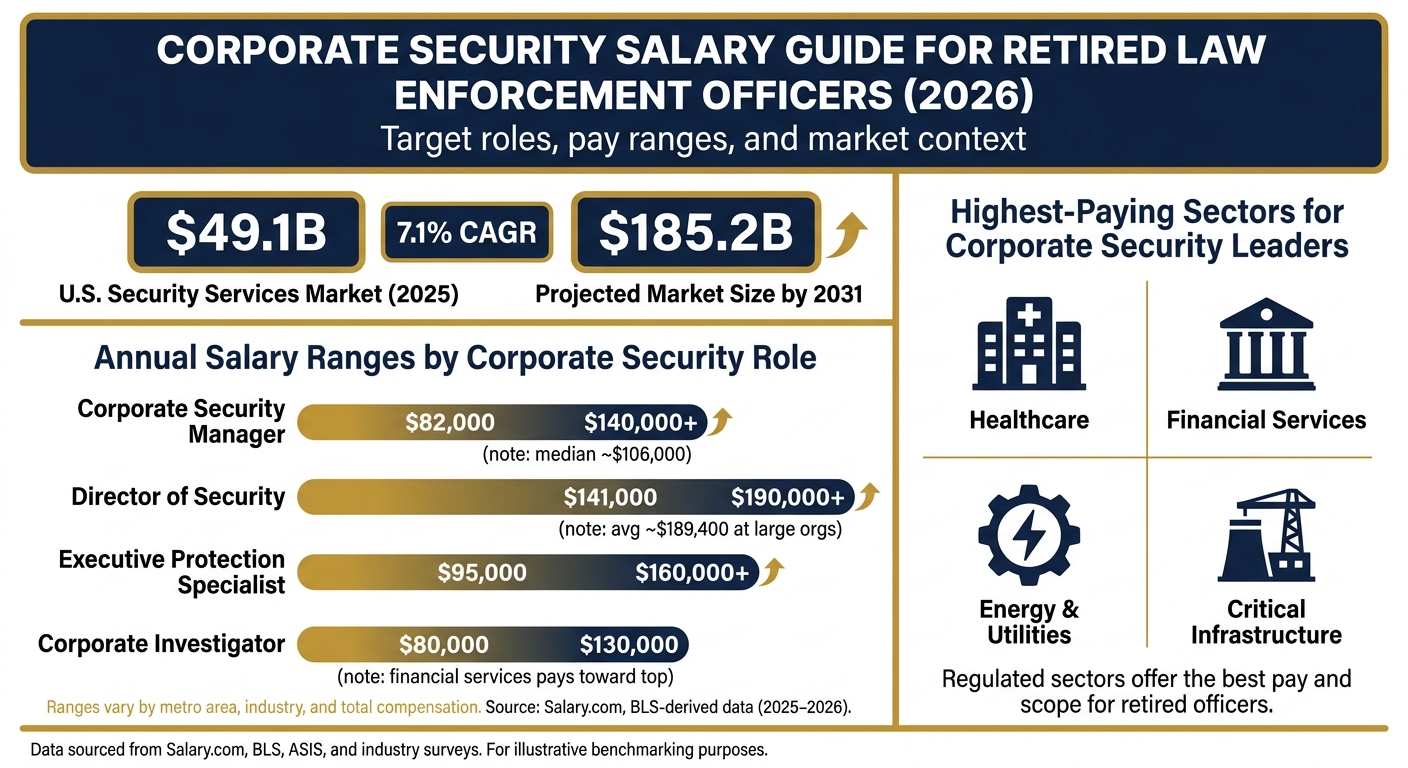
Corporate Security Salary Guide for Retired Law Enforcement Officers (2026)
You can see this shift right away in market size and hiring demand. The U.S. security services market is about $49.1 billion in 2025, within a broader sector expected to hit $185.2 billion by 2031 at a compound annual growth rate of about 7.1%. That kind of scale points to steady demand for supervisors, investigators, and security managers.
About 1.3 million Americans work as security guards, which makes protective services one of the largest job groups in the country. Front-line guard turnover is still high, and that keeps pressure on employers to hire supervisors, trainers, and managers. Retired officers can step into that gap as they transition into the private sector. They can steady teams, coach supervisors, and take charge during hard incidents.
The larger change, though, isn’t just more jobs. It’s a different way companies run security. More organizations now fold security into Enterprise Security Risk Management (ESRM) and business continuity planning. That ties physical security, investigations, crisis response, and workplace safety to enterprise risk management.
In plain English: security is no longer sitting off to the side. It’s being pulled into the same room as HR, legal, operations, and IT. That setup favors people who can lead investigations, coordinate incidents, and work well across departments. For retired officers, that matters a lot. Many already know how to make decisions under pressure, brief leadership, and deal with sensitive cases.
Large employers tend to pay the most for this level of leadership. At enterprise companies with 5,000+ employees, security manager salaries average about $117,000+. Regulated sectors such as financial services, healthcare, energy, and critical infrastructure often pay more.
These changes are also widening the pay gap between front-line work and leadership roles. Put simply, pay climbs fast as you move from guarding into corporate security management. The table below shows rough annual pay for roles that often line up well with a retired officer’s background.
| Role | Approx. Annual Salary Range (USD) | Notes | Source(s) | Year |
|---|---|---|---|---|
| Corporate Security Manager | $82,000–$140,000+ | Median around $106,000; higher at large enterprises | Salary.com, BLS-derived | 2025–2026 |
| Director of Security | $141,000–$190,000+ | Average around $189,400 in larger organizations | Salary.com | 2025–2026 |
| Executive Protection Specialist | $95,000–$160,000+ | Estimated range; varies by metro and industry risk profile | Comparable security manager data | 2025–2026 |
| Corporate Investigator | $80,000–$130,000 | Approximate range; financial services often pays toward the top | Security manager and investigative role averages | 2025–2026 |
Pay changes by metro area, industry, and total compensation, so use these numbers as benchmarks, not promises.
If you’ve led teams, managed hard investigations, or handled critical incident command, aim for the middle to upper end of these ranges. The key is to translate law enforcement experience into business terms. Talk about incident command, investigations, and threat response in a way that makes sense to corporate leaders. That matters even more as security tech and cyber-physical risk keep reshaping these roles.
As security budgets go up, the work itself is shifting too. In 2026, corporate security is pulling physical security, cyber, insider risk, and continuity into one shared operating model. Badge access, CCTV feeds, IoT sensors, identity data, endpoint telemetry, and network alerts are more often viewed in the same operating picture.
The clearest example is the Global Security Operations Center (GSOC). GSOCs bring together access control, video, identity, and network alerts so teams can triage one incident in one place instead of across three separate systems. Retired officers who have worked in fusion centers, task forces, or command posts already understand the escalation and coordination style GSOCs rely on. That makes GSOC leadership a natural move for many of them.
AI is changing that same setup in a big way. By 2024, more than 78% of modern CCTV systems had AI analytics built in, and about 48% of enterprises worldwide used AI-powered video analytics for security and operations automation. That changes the day-to-day job. Analysts spend less time staring at live camera feeds and more time reviewing AI-generated risk scores, checking alerts, and making judgment calls. That shift plays well with the pattern recognition and behavior-based judgment many retired officers already bring.
The same convergence is also pushing more companies to formalize insider-risk programs. Insider threat programs are now standard, and survey data points to more frequent incidents. In a 2024 survey, 48% of respondents said insider attacks had become more frequent over the previous 12 months. In the U.S., guidance stresses multidisciplinary teams that combine security, HR, legal, physical security, and operations. For retired officers used to working across agencies and departments, that can open a direct path into insider-risk investigation work.
Law enforcement experience gives people a strong base. But in 2026, corporate security also asks for comfort with tech, systems, and data. Here’s how the main trends line up with what retired officers already know and where they may need more training.
| Trend | Existing Law Enforcement Strengths | Required Upskilling Areas |
|---|---|---|
| GSOCs | Incident command, ICS, multi-agency coordination, and situational awareness across large areas | GSOC platforms, cyber incident workflows, and ticketing and data-driven metrics |
| AI monitoring | Pattern recognition, behavioral red-flag spotting, surveillance footage review, and context interpretation | Basic AI/ML concepts, interpreting risk scores, validating alerts, platform-specific training, and privacy rules |
| Insider risk & identity-based threats | Interviewing, behavioral assessment, workplace violence investigations, and sensitive personnel matters | Insider risk frameworks, identity and access management concepts, and employment law and data protection constraints |
| Cloud-based access control & security systems | Physical security fundamentals: perimeters, access levels, visitor management, and facility incident response | Cloud dashboards, role-based permissions, HR/IT system integration, and basic cyber hygiene such as multifactor authentication and secure configurations |
| ERM and governance | Threat prioritization by severity and likelihood, policy enforcement, and compliance experience | Formal ERM concepts, risk registers and heat maps, and translating threats into financial and regulatory exposure terms |
The gap usually isn’t as big as it looks. GSOC demos, sandbox practice, and short courses can help retired officers get up to speed fast.
As security gets tied more closely to tech and day-to-day operations, companies are putting tighter rules and oversight around it.
State workplace-violence laws are pushing employers to build written prevention programs, with extra pressure on healthcare, social services, and retail. California’s SB 553, which took effect July 1, 2024, and New York’s Retail Worker Safety Act, which set a similar mandate by June 2, 2025, are pushing employers to formalize compliance programs and bring in people who can run them. For retired officers, that opens the door to find a job in program design, investigations, and threat assessment.
Threat Assessment Managers work across HR, legal, security, and behavioral health. Workplace Violence Prevention Specialists put together risk assessments, access controls, training, and response protocols. Corporate Investigators document incidents for discipline, litigation, or law-enforcement coordination.
Retired officers already come in with skills in risk assessment, interviewing, evidence handling, report writing, and incident command. The main areas where they may need more training are HR/EEO compliance, data privacy, and corporate governance. Still, the core investigative skill set is already in place.
That same compliance push is also opening up director-level roles in regulated sectors.
These same forces are moving security out of a support role and into executive leadership. In regulated and high-risk sectors, security is now becoming a director-level function. Boards are getting more security risk briefings on incidents, controls, and risk posture. SEC rules adopted in 2023 require public companies to disclose which board committee oversees cybersecurity risk and which management roles are responsible for assessing and managing it. That same oversight model is starting to extend to physical security and workplace safety.
ESG reporting adds more pressure. Companies now report safety incident rates, fatalities, and training completion as metrics that investors see. Once safety data shows up in ESG reporting, boards pay attention. And when they do, they need security leaders who can own those numbers.
In high-risk sectors, director-level security roles often include:
In the energy and utility sector, guidance calls for an executive owner of enterprise security with oversight across IT, operational technology (OT), and physical security, backed by a Security Governance Board.
Retired officers line up well with these jobs because they already brief leadership, manage incidents, and coordinate across departments. Former captains, commanders, and chiefs stand out in particular. They’re used to presenting risk assessments to oversight bodies, working under public accountability, and coordinating across multiple agencies and departments. That maps directly to board reporting and cross-functional security leadership.
Those shifts in the market and in boardroom expectations change two things for retired officers: how you present your background and where you look for work.
The big move is simple. Take police experience and translate it into business results: risk reduction, compliance, cost avoidance, and employee safety.
That means swapping internal law enforcement titles and jargon for language a hiring manager in the private sector can size up fast. For example, patrol sergeant can become supervised 10–15 staff, managed schedules, coached performance, and led incident response. Conducted threat assessments can become performed behavioral threat assessments and built mitigation plans to prevent workplace violence.
Numbers help a lot. They turn a general claim into something a company can judge. Phrases like supervised 12 officers; reduced use-of-force complaints by 30% through policy enforcement and training or led investigations that resulted in a 20% reduction in repeat incidents give employers a clearer picture of scope and results.
That reframing gets even stronger when you pair it with the right credential. ASIS CPP is the best-known credential for corporate security leaders. CPP fits security leadership, PCI fits investigations, and PSP fits access control, facility security, and GSOC work. UC Irvine launched an executive protection certificate in February 2026 for professionals moving into executive and corporate protection.
Once your résumé lines up with the role, the next step is finding employers that already want that background.
A focused search usually leads to better-fit roles in less time. OfficerList is a job marketplace for active and retired law enforcement officers seeking corporate security and other specialized roles. It also offers job postings, resume tools, and a secure community.
That focus matters because some employers limit hiring for certain security roles to active-duty or retired police officers and sheriff’s deputies. A platform built around law enforcement professionals puts those openings in front of the people they’re meant for.
With the right wording and the right credentials, the search gets much tighter. Corporate security in 2026 rewards retired officers who can lead investigations, protect people, and manage risk in business terms. Match your background to one target role, translate your experience into business language, close one skill gap, and search through channels built for law enforcement professionals.
Match your law enforcement background to the job you want. Tactical leadership or event management often lines up well with risk assessment and workplace violence prevention. Detective work can connect directly to corporate investigations, fraud detection, or internal misconduct reviews. Command staff experience usually fits planning, policy work, and big-picture decision-making.
Your day-to-day style matters too. If you like working with people and being out front, executive protection may be a good fit. If you lean more toward reports, systems, and process, look at compliance, risk management, or incident response analysis.
OfficerList can help you turn that experience into language employers understand, especially when they’re looking for the training and judgment that law enforcement work builds over time.
Before you apply, start with a skills audit. Look at your law enforcement background and turn it into business-friendly language. The goal is simple: show employers how your work connects to crisis management, leadership, investigations, and measurable results.
That means swapping out job terms that may feel too agency-specific for wording hiring teams will grasp right away. For example, talk about managing high-pressure incidents, leading teams, running investigations, reducing risk, and improving outcomes. If you can attach numbers to the work, even better. Think in terms of response times, case volume, team size, loss prevention, or incident reduction.
It also helps to build comfort with tools and systems used in private-sector roles. Focus on:
Certifications like ASIS CPP, PSP, PCI, or CISSP can also help strengthen your credibility. On top of that, learn the basics of corporate norms, financial metrics, and compliance. OfficerList can help you spot in-demand skills.
Retired officers often earn the most in specialized security, investigations, and risk management.
Some of the best-paying roles tend to show up in a few sectors: