
Conclusion: Corporate security leadership offers lucrative opportunities for retired law enforcement officers. With the right skills and credentials, transitioning into this field can lead to rewarding careers.
Corporate security leadership encompasses several critical positions, each with distinct responsibilities. At the top is the Chief Security Officer (CSO), responsible for shaping and managing the organization’s global security strategy. This role involves overseeing both physical and digital security measures, with a focus on mitigating risks at the highest level. CSOs typically earn base salaries exceeding $200,000. Professionals looking to transition into these high-level roles can find a job through specialized security career platforms.
The Director of Corporate Security, reporting directly to the CSO, earns between $100,000 and $180,000 annually. This role focuses on managing departmental operations, ensuring compliance with regulations, coordinating responses to incidents, and developing security protocols that align with the company’s overall objectives.
Security Managers handle the day-to-day operations, leading teams and conducting ongoing risk assessments. Their salaries range from $70,000 to $110,000 annually. Meanwhile, Risk Analysts concentrate on identifying and evaluating potential threats, while Emergency Management Directors focus on disaster recovery and preparedness planning.
Many of the skills required for corporate security leadership align closely with those developed in law enforcement careers. Transitioning from law enforcement to these roles often feels like a natural step due to the shared emphasis on crisis management, operational planning, and investigative work.
For instance, law enforcement professionals are trained to manage high-pressure situations, such as responding to emergencies or mitigating workplace violence – skills that are invaluable in corporate security. Their experience in operational planning equips them to design effective security protocols and emergency response strategies.
Additionally, the investigative expertise gained in law enforcement, such as conducting surveillance, performing background checks, and leading internal investigations, is highly relevant to corporate environments. Organizations also value their ability to mentor and guide security teams, leveraging years of practical experience. This unique combination of skills makes retired law enforcement officers particularly well-suited for leadership roles in corporate security.
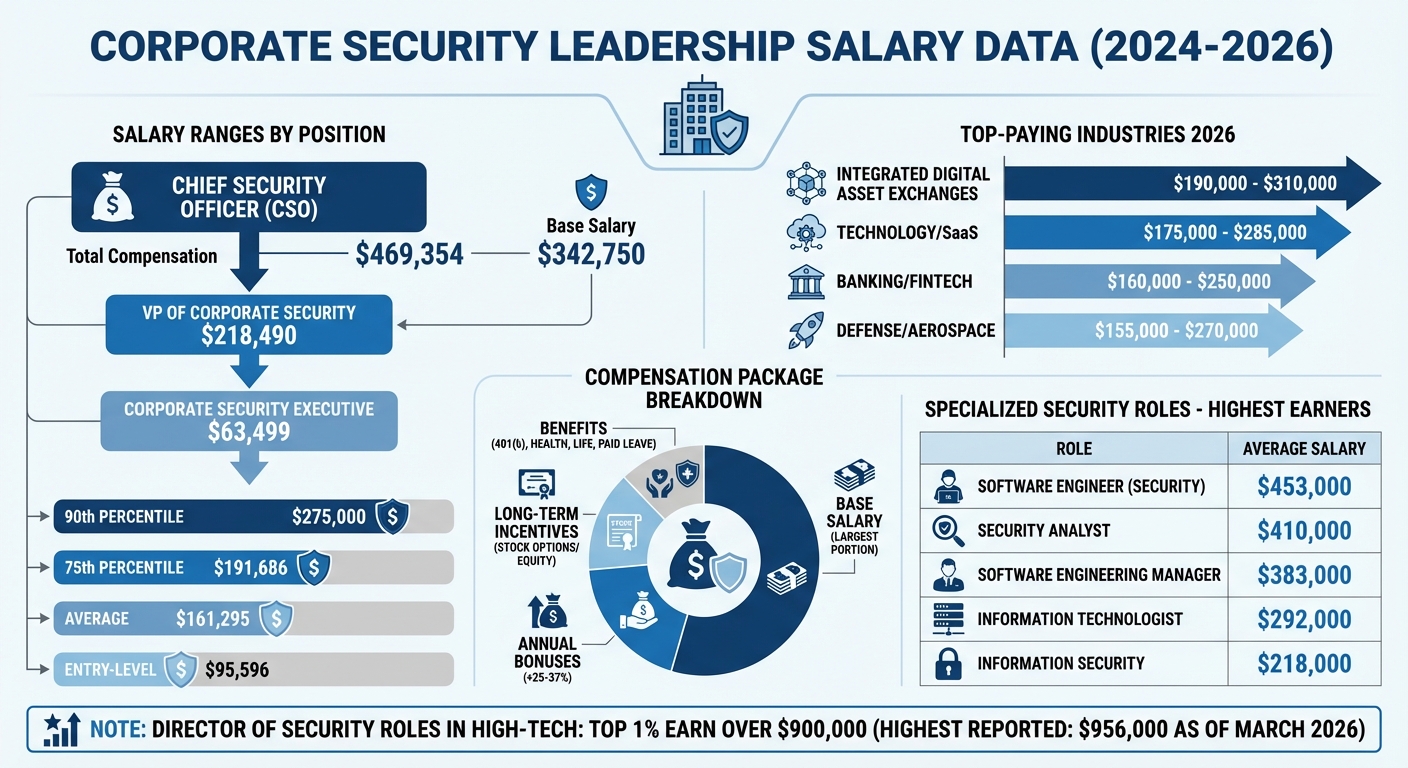
Corporate Security Leadership Salary Ranges by Role and Industry 2024-2026
Chief Security Officers (CSOs) typically earn a base salary of around $342,750, which can climb to about $469,354 when bonuses are included. Vice Presidents of Corporate Security take home approximately $218,490, while mid-level Corporate Security Executives average closer to $63,499. These figures offer helpful benchmarks, especially for law enforcement professionals looking to transition into corporate roles.
When looking at percentile data, security leaders in the 90th percentile earn about $275,000, while those in the 75th percentile make roughly $191,686. The average salary across the field is around $161,295, and entry-level roles start at approximately $95,596.
Compensation also varies significantly by industry. In 2026, Integrated Digital Asset Exchanges (UEX) are expected to offer the highest salaries, ranging from $190,000 to $310,000. Other sectors follow closely, including Technology/SaaS ($175,000 to $285,000), Banking/Fintech ($160,000 to $250,000), and Defense/Aerospace ($155,000 to $270,000).
Corporate security compensation typically includes three key components: base salary, annual bonuses (which can add 25–37%), and long-term incentives like stock options or equity. Benefits often include 401(k) plans with employer contributions, comprehensive health insurance (covering medical, dental, and vision), life and disability insurance, and paid leave.
In high-stakes industries like Integrated Digital Asset Exchanges and Big Tech, compensation packages are designed to reward professionals for maintaining constant vigilance and managing "Enterprise Resilience." This approach blends physical and digital security strategies. Security leaders are also increasingly recognized for delivering measurable business outcomes, such as lowering insurance costs or preventing losses with AI-driven threat forecasting.
These evolving compensation structures reflect the growing importance of security roles in modern corporate environments.
Since 2019, compensation for corporate security leadership roles has consistently increased. Between 2019 and 2024, total pay for Chief Security Officers (CSOs) rose by 8.1%, while Managers of Corporate Investigations saw a notable 22.3% jump. This upward momentum carried into 2025, with Chief Information Security Officer (CISO) compensation growing by an average of 6.7%.
A key driver of this growth has been equity compensation, particularly in larger public companies. For instance, the information technology sector’s 36% growth in 2024 significantly boosted the equity components of security leadership pay packages. Public company security leaders experienced a 6.1% increase in cash compensation in 2024, compared to just 1.7% for their private sector counterparts. Base salaries also rose by 4.1%, outpacing many other industries.
This increase in pay reflects a broader recognition of the value security leaders bring to organizations. Their contributions to risk reduction, insurance savings, and compliance improvements are increasingly viewed as essential to business success. As Stephen W. Walker, Partner at Foushée Group, Inc., aptly stated:
The security function itself has blossomed based on necessity.
Such trends highlight the growing strategic importance of security leadership roles in today’s technology-driven business environment. The steady rise in pay also aligns with the increasing demand for highly skilled security professionals.
The steady rise in salaries parallels the surging demand for experienced security leaders. This demand is fueled by escalating threats to critical infrastructure and stricter regulatory frameworks. With cyber risks now ranked among the top global business concerns, security professionals are increasingly included in high-level strategic discussions. A clear sign of this shift: 62% of public company security leaders now report to the Board on a quarterly basis – a 14% increase compared to the previous year.
Organizations are also placing a premium on crisis management expertise, often found in individuals with law enforcement backgrounds. These skills, honed in high-pressure environments, are highly valued for their ability to drive operational success during critical situations. As Nick Kakolowski, Senior Research Director at IANS, observed:
CISOs have firmly established themselves as business leaders, not just security operators. Their pay stability this year reinforces how indispensable cybersecurity leadership has become to enterprise risk oversight.
To attract and retain top talent, companies are offering enhanced benefits. For example, 50% of security leaders are now covered by Directors and Officers (D&O) insurance, a significant increase from 40% in 2024. Additionally, pay transparency laws have empowered security leaders to better assess their market value, contributing to sustained salary growth.
Your salary as a corporate security leader isn’t determined by just one factor. Instead, several elements come into play, shaping your overall compensation. By understanding these variables, you can better evaluate your market value and negotiate more effectively when exploring new opportunities.
Where you work plays a major role in how much you earn. Salaries often reflect the cost of living and the demand for specific security skills in a given area. For instance, regions with a high demand for security expertise and higher living costs typically offer larger paychecks. Conversely, areas with lower living expenses may provide more modest compensation. Tools like OfficerList allow law enforcement professionals to explore salary options across different regions, helping them align their skills with market expectations. Additionally, your employer type – whether it’s a large security firm or a private client – can influence your pay structure.
But location isn’t the only factor – your background and qualifications also significantly impact your earning potential.
Your experience in law enforcement is a valuable asset in the corporate security world. Recruiters often prioritize active and retired law enforcement professionals for their proven expertise and professionalism. As one recruiter put it:
"OfficerList is an amazing resource for recruiters! Candidates are experienced, respectful and 100% professional. I highly recommend for attracting the highest level of talent."
- Leslye, Recruiter
Employers focus heavily on "skills and training" when evaluating candidates, meaning your specialized credentials can make or break your candidacy for top-tier roles. To stand out, tailor your resume to highlight how your law enforcement training translates into corporate security value. Demonstrating how your discipline and field experience align with specific corporate needs can greatly enhance your appeal to potential employers.
The size of your employer and the industry you work in also play a big part in determining your salary. Specialized areas within security – like AI governance, cloud security, and identity and access management – are currently among the highest-paying fields. Security leadership roles within tech-heavy industries, such as software engineering or IT, often come with significantly higher compensation than traditional corporate security positions.
For example, while Chief Information Officers earn an average of $161,295 annually, Directors of Security in high-tech environments average $341,000, with the top 1% earning over $900,000. The highest reported salary for a Director of Security as of March 2026 is $956,000.
| Specialized Security Leadership Role | Average Annual Salary |
|---|---|
| Software Engineer (Security Focus) | $453,000 |
| Security Analyst | $410,000 |
| Software Engineering Manager | $383,000 |
| Information Technologist | $292,000 |
| Information Security | $218,000 |
To boost your earning potential, consider targeting roles in software engineering or security analysis. Gaining credentials or experience in high-demand areas like AI governance and cloud security can make you a strong candidate for these lucrative positions. For retired law enforcement officers transitioning into corporate security, focusing on high-tech or specialized roles could be a smart career move.

If you’re ready to put your law enforcement background to work in the corporate security world, OfficerList is a platform designed with you in mind. Founded in 2016 by Rich Edelman, a retired NYPD officer, OfficerList connects law enforcement professionals with employers who value their skills and experience.
OfficerList is packed with job postings from security companies, corporations, and organizations that specifically seek candidates with a law enforcement background. The platform highlights roles such as Armed Security, Personal Protection, Investigations, and Armed Chauffeur services.
For instance, in late 2025, a Manhattan private school posted a Part-Time School Safety Officer position requiring a retired NYPD or law enforcement background and an active NYS Security Guard License for an evening shift from 3:00 PM to 11:00 PM. Around the same time, Freelance Surveillance Investigator roles were also listed, targeting former detectives or SIU members in the Greater NYC area. These positions allowed candidates to set their own rates and schedules for covert video and activity assignments.
Recruiters have also praised the platform for its ability to connect them with top-tier talent:
"OfficerList is an amazing resource for recruiters! Candidates are experienced, respectful and 100% professional. I highly recommend for attracting the highest level of talent."
- Leslye, Recruiter
Beyond job listings, OfficerList offers tools to help streamline the job search process for law enforcement professionals.
OfficerList provides a variety of tools to support retired law enforcement professionals transitioning to corporate security roles. One standout feature is the LiveResume tool, which converts your law enforcement experience into a resume tailored for industry-specific roles. This feature also enables one-click applications, making the process seamless.
The platform further enhances the job search experience with automated email alerts that notify you when new, relevant positions are posted. Additionally, it includes a secure forum where users can network and exchange insights.
One retired officer shared his success story:
"I was on the website looking for a part time job and found one within a week. I will highly recommend this website to all LEO’s."
- Sergeant Jeffrey, Retired NYPD
For retired law enforcement officers, corporate security roles present strong earning opportunities. Salaries for Directors range between $100,000 and $180,000, while Chief Security Officers (CSOs) typically start above $200,000, with packages in high-growth industries projected to reach up to $310,000 by 2026.
Compensation depends on several factors, including location, industry, and qualifications. Urban hubs like Washington, D.C., New York City, and Silicon Valley often offer higher pay. Sectors like finance, healthcare, and technology tend to provide more competitive salaries due to stricter regulations and the need for advanced data protection. Certifications also play a big role – credentials like CISSP can boost salaries by 20–30%, while holding a Top Secret clearance may add another 10–20%. These elements are vital as the demand for security leadership continues to expand.
The job market for security leaders is shifting, with 32% growth expected through 2030. By 2026, over 40% of new Security Directors are anticipated to come from digital-first or cross-functional backgrounds rather than traditional law enforcement. To stay competitive, consider supplementing your tactical expertise with certifications in areas like risk management, digital forensics, or cybersecurity.
With the sector growing rapidly and offering attractive compensation, now is an ideal time to make the transition. OfficerList connects former law enforcement professionals with employers seeking their unique skills. The platform offers tools to translate your experience into corporate security roles and provides automated job alerts to keep you updated on opportunities. Whether you’re aiming for a Security Manager position or targeting a Director-level role, OfficerList is tailored to help you succeed.
Your career in law enforcement has equipped you with the expertise and leadership skills needed to excel in corporate security. By applying these strengths strategically, you can position yourself as a valuable asset in this evolving field.
Emphasize your expertise in risk assessment, security protocols, crisis response, and leadership in security operations. These skills highlight your ability to protect organizational assets and handle complex security challenges, positioning you as a strong contender for Director or Chief Security Officer (CSO) roles.
Earning certifications such as the Certified Protection Professional (CPP) or Physical Security Professional (PSP) can boost your earning potential in corporate security positions. Employers place a high value on specialized security and risk assessment credentials, which can lead to noticeable increases in salary.
To weigh equity and bonuses effectively, focus on their current value, future potential, and how well they align with your personal goals. When evaluating equity, consider factors like market trends, the company’s growth prospects, and the likelihood of liquidity events such as IPOs or acquisitions. For bonuses, look into whether they are tied to performance or offered as guaranteed cash, and analyze how they fit within your total compensation structure. Ultimately, make sure both equity and bonuses match your financial objectives and comfort with risk.